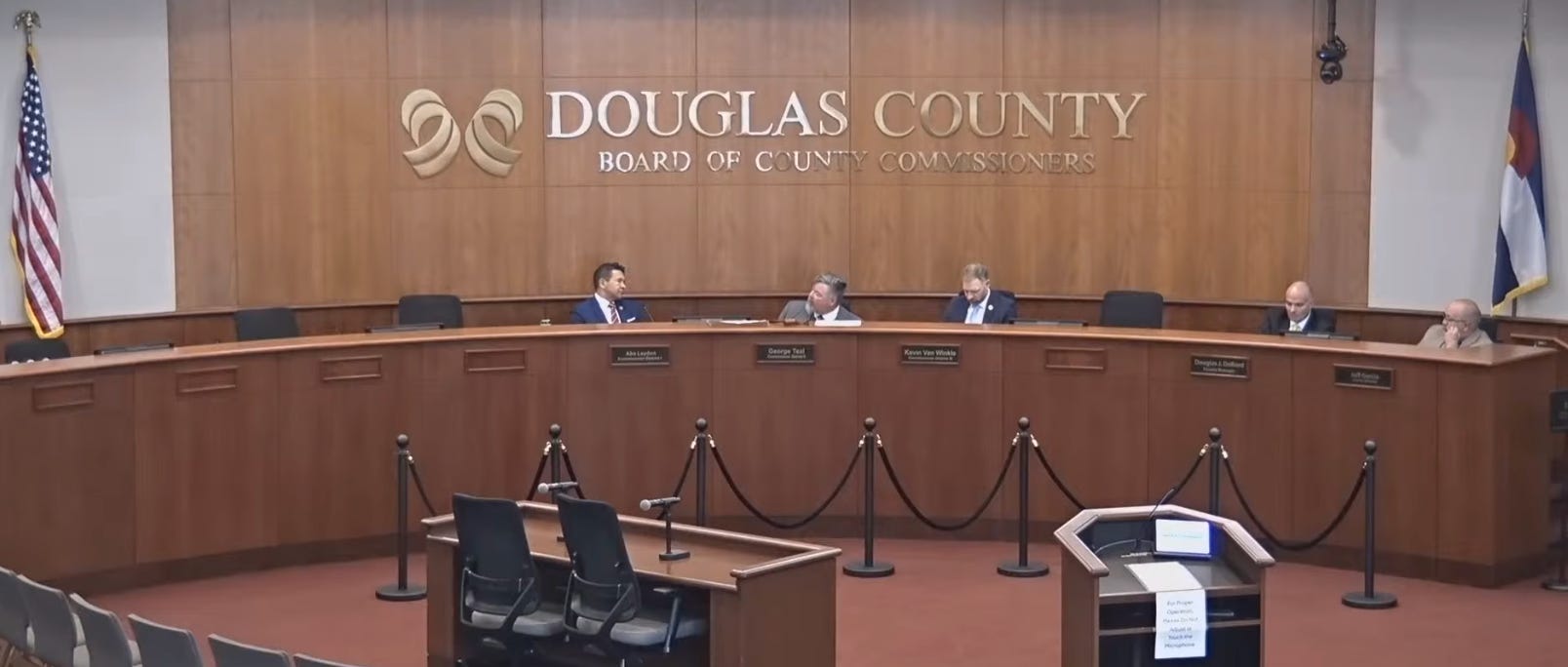
The Petition to Expand the Board of Douglas County Commissioners
What would it do? What are the costs? What’s the timeline? And more.
Democrats and Republicans don’t agree about much in Douglas County, but the “3 to 5 Petition” has rare, bipartisan support in the county. The goal of the petition is to let Douglas County voters decide whether the Board of County Commissioners (BOCC) should expand from its current three members to become a five-member board.
Organizer Angela Thomas describes the petition as a grassroots, bipartisan effort, and says, “We have volunteer circulators who are Republicans, Democrats, and Independents working all over Douglas County to collect signatures.” Those volunteers aim to collect more than 15,000 signatures between now and mid-July. If they succeed, Douglas County voters will decide in November whether to expand the BOCC to five members — and how that expansion would work.
What would the petition allow voters to decide?
If supporters collect enough signatures, voters will have the opportunity to decide:
Whether the Douglas County Board of Commissioners should be expanded from a three-member board to a five-member board.
If so, by what method that expansion should be accomplished:
Five commissioners elected by the voters of each district, OR
Three commissioners elected by the voters of each district, plus two commissioners to be elected by the entire county (at-large).
Currently, each County Commissioner must reside in the district they represent, but they are elected at-large by the voters of the whole county, not just by the voters in their specific districts.

Why expand the commission and vote by district … and at what cost?
Thomas estimates the cost of the expansion at $500,000. She itemizes the costs at a total of $250,000 per commissioner, per year:
$150,000 - the upper end of the current salary range
$ 36,000 - additional costs of benefits, including retirement match
$ 64,000 - travel, meals, and other incidental expenses
HB25-1265, a bipartisan bill sponsored by Rep. Bob Marshall (D), Sen. Larry Liston (R), and Sen. Michael Weissman (D), in 2025 was designed to expand county commissions of large Colorado counties. The bill did not pass, but it contained an estimated cost of “$350,000 or more” per additional commissioner, without itemized detail. A high-end estimate of $700,000 per year to add two new commissioners in Douglas County represents a little more than one-tenth of one percent (~ 0.12%) of the county’s $600+ million budget.
There would also potentially be one-time costs for redistricting. Just passed in 2026, HB26-1038 requires boards of county commissioners to appoint independent redistricting commissions to develop redistricting plans. Those redistricting committees must be “made up equally of members affiliated with the two largest political parties, and members not affiliated with a political party, to develop redistricting plans.” The estimated cost of redistricting is $75,000 to $135,000.
Why incur those costs?
Supporters say the measure would create better representation and increased accountability in a county that has grown to over 400,000 residents with a budget exceeding $600 million. “With only three commissioners,” said Thomas, “it takes only two people to agree to policy and spending decisions that impact the entire county.” She believes voting by district would give every area of the county a clear voice and make county commissioners more responsive and accessible to the people who elect them.
Former Commissioner Lora Thomas (no relation to Angela Thomas) says it would also make running for county commissioner accessible to more residents of Douglas County. According to Lora Thomas, a single countywide mailer currently costs around $20,000, and to win a county-wide election, commissioners have, in past elections, spent upwards of $250,000 on their campaigns. She reasons that replacing the current at-large elections with district-based voting would significantly diminish the financial barriers to entry for people who want to serve as county commissioners in Douglas County.
Motivated to make the commission more representative and accountable to voters, Former Commissioner Thomas says she had a front row seat to how easily a three-member board can be taken over by just two commissioners. Thomas alleges that in November 2020, shortly after George Teal won the general election, Commissioner-elect Teal called her and stated, “Abe (Laydon) and I agreed that I will back whatever Abe wants, and he will back whatever I want. We have the county covered, so there’s no need for you to even come to work.” Thomas acknowledged that on a five-member board, that kind of alliance building could still happen, but she believes the five commissioner model offers greater accountability to constituents.
Lora Thomas was one of three Douglas County residents who sued the Douglas County Commissioners in 2025, alleging that they violated Colorado Open Meeting Laws. A panel of three appellate judges ruled on April 2, 2026 that the commissioners did violate open meeting laws by holding 11 closed, unnoticed meetings between December 2024 and April 2025 in the process of deciding to hold a special election to initiate Home Rule in Douglas County.
The appellate court also remanded the case back to the Douglas District Court to determine whether the commissioners have continued to violate Colorado’s Open Meeting laws. The County plans to appeal to the Colorado Supreme Court, and the plaintiffs have offered a settlement in an effort to prevent the County from spending additional tax dollars on litigation.
Concerns about representation and citizen input in Douglas County have increased after the Home Rule defeat in June 2025. Since then, the three sitting commissioners have ended general public comment at their biweekly Business Meetings and turned off all comments on their social media pages.
In a recent development, the Commissioners have clearly established that additional restrictions on public comment will be the norm. A May 12, 2026 Business Meeting announcement on their Facebook page reads:
“Public testimony will be welcome for specific items on the agenda, listed under ‘Regular Agenda’ … Please make sure to sign up with staff outside the Hearing Room before the start of the meeting. The Chair of the Board of County Commissioners will use the sign-in sheet at his discretion to run the meeting.”

How do other counties elect commissioners?
The Colorado Constitution has mandated that all counties have a minimum of three commissioners and provides for up to five-member boards. Douglas County is the 6th largest county in Colorado. Three of the top five counties — El Paso, Arapahoe, and Adams — already have five county commissioners. Two counties smaller than DougCo also have five — Weld and Pitkin.
Rep. Bob Marshall (D-Highlands Ranch) sponsored HB26-1038 in the 2026 legislative session that would have required expansion to five commissioners for any county with more than 70,000 residents. That 2026 bill, the fourth Marshall has sponsored since 2023 to expand commissioner boards in large counties, was approved in the Colorado House but did not advance from the Senate. Marshall’s argument for his repeated efforts at legislation is simple:
“Multiple Colorado counties now have populations of hundreds of thousands, with budgets in the hundreds of millions. Yet their political structures remain the same from more than a century ago: electing three commissioners at-large.
At-large voting excludes political minorities from a voice in their local government, no matter who is the political minority. Early in American history, a majority of states voted at-large to elect congressional delegations. The resulting unrepresentative political power led Congress in 1842 to mandate all states use district-based elections for Congress that we know today, over the objections of ‘States Rights’ and ‘Local Control’ made by opponents to that reform.”
Current commissioners and candidates on the ballot initiative
In a recent response to Denver 7 News, Commissioner Abe Laydon offered simply, “Things rarely improve by adding politicians.”
Conversely, Commissioner George Teal expressed his support of the petition to expand to a five-member board, rationalizing that it would “effectively eliminate term limits in Douglas County.” On that point, Teal is misinformed according to Colorado law and a clarifying Attorney General opinion.
See Teal’s statement at about 1:41 in this interview with Denver 7 News.
According to Colorado Counties, Inc. (CCI), the citizens of Colorado passed an amendment to create Article 18, Section 11 of the Colorado Constitution in 1994. Section 11 limits local elected officials, including county commissioners, to two consecutive four-year terms. It also contains a provision that allows local governments to seek voter approval to change those term limits. Some counties have made voter-approved changes, but Douglas County is not one of them, despite efforts in 2003, 2004, and 2011 to extend to a three-consecutive-term limit.
Section 11 provides a clear definition of the term consecutive:
“For purposes of this Section 11, terms are considered consecutive unless they are four years apart.”
That, together with a July, 2000 Formal Opinion issued by former Attorney General Ken Salazar, clarifies that redistricting and/or changing from at-large to district voting will not allow a term limited official to run without the four-year gap prescribed in Section 11. Salazar’s detailed opinion concludes:
“Moving to a new district will not allow a term limited elected official to run immediately for election to the same body. Redistricting will not allow a term limited official to run immediately for election to the same body. Finally, a change in the at-large or specific district nature of the seat the elected official currently occupies will not allow a term limited elected official to run again immediately for election to the same body.”

Commissioner Abe Laydon is term-limited at the end of 2026, and three candidates are in the running for his vacant seat. Irene Bonham is the sole Democratic candidate on the ballot. Jake Bockenfeld and John Diak will face off in the Republican primary election on June 30, 2026 to decide which of them will run against Bonham in the November general election.
Bonham believes Douglas County has outgrown a three-member commission. “Each commissioner represents over 130,000 people…A five-member board would reduce the number of constituents each commissioner represents, allowing for more direct engagement and a deeper understanding of local issues,” she wrote in a recent blog post.
In response to our request for a statement for this story, Bonham replied,
“Yes, I support the petition to expand the Douglas County Board of Commissioners from 3 to 5 members and have signed it. Douglas County has grown into one of the largest counties in Colorado with nearly 400,000 residents and communities with very different needs and priorities. But our county government structure has not kept pace with that growth…In a three member system, two commissioners alone make up a majority of the board. That’s a lot of power…Ultimately, I see this as a good-governance issue, not a partisan one. As Douglas County continues to grow, our system of representation should evolve with it.”
Bockenfeld opposes expansion of the Board. In an April 7 debate with Diak, Bockenfeld asserted that an expansion would create “voting blocs” in which “urban areas would outvote rural areas…so our rural constituents would no longer have a voice on the Board of County Commissioners.”
He concluded, “Douglas County has always had three. Why would we need more now? What’s changed other than the radicals and the Gang of Four trying to take over Douglas County?”
In response to our request for a statement for this story, Bockenfeld provided this statement.
“I do not believe expanding government is the right solution. Adding two more commissioners means adding more salaries, staff, administrative costs, and taxpayer burden. All without any clear benefit to the citizens. Before growing government, we should be focused on making the current system work more efficiently.”
In the same April 7 debate, Diak said, “I’m open to it,” and explained, “When you have five, you have the ability to have more minds in a discussion.” He went on to describe how a larger board would make it possible for two commissioners to work together to discuss and refine ideas without violating open meeting laws so that better proposals can be brought before the entire board to achieve better outcomes for the community.
Diak did not respond to our request to provide a statement for this story.
What happens next?
Angela Thomas sums up the effort she’s spearheading this way:
“This initiative is about strengthening local democracy by ensuring Douglas County residents have better representation, more accountability, and more voices at the table as our county continues to grow. Expanding from three commissioners to five is a modest investment in better governance that gives communities across Douglas County a stronger voice in the decisions that shape their daily lives.”
She plans to submit the petition to the County Clerk in late July. “Until then,” she says, “watch for our volunteer circulators wherever you go in Douglas County.”
According to Thomas, August 3rd is the final deadline to submit signatures to the County Clerk. The Clerk then reviews signatures and determines whether the issue qualifies for the ballot. The deadline for that decision by the County Clerk is September 2nd, and, if the issue qualifies, it will appear on the November 2026 election ballot for Douglas County voters to decide.


Thanks for this! Informed voters created a strong democracy.
I am curious why Jake Bockenfield thinks rural areas should have a larger proportionate say in our governance. They are more equal?