

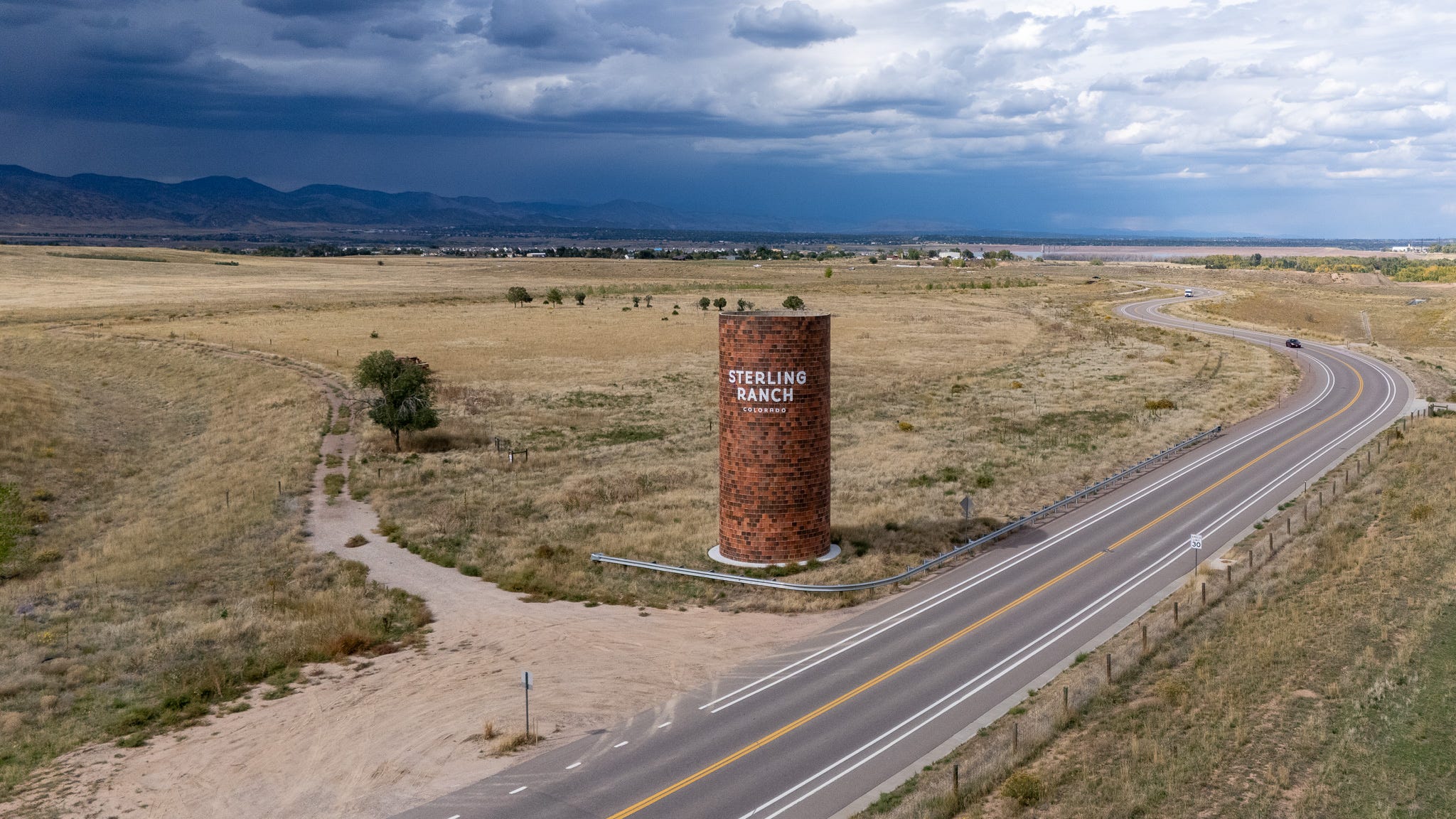
A question hanging over Sterling Ranch has been whether the community’s signature promise — building homes that use dramatically less water than standard Colorado suburban development — was real or just a developer’s marketing claim.
New water delivery records obtained by the Lantern from Aurora Water suggest that, at current scale, the development is meeting its efficiency standards. But the data raises different questions about the debts incurred to develop Sterling Ranch.
Aurora Water supplied Dominion Water & Sanitation District — the entity that delivers water to Sterling Ranch — a total of 533 acre-feet of water in 2025, under three separate intergovernmental agreements. With approximately 2,980 homes in Sterling Ranch by the end of December 2025, according to figures provided by the community’s developers to the Denver Business Journal, that works out to roughly 0.179 acre-feet per home, per year.
That figure is consistent with Sterling Ranch’s publicly stated efficiency target of 0.18 acre-feet per home annually, and is well below the 0.25 acre-feet per home threshold that Colorado’s Chief Engineer identified as the state’s standard of concern in a letter sent to Sterling Ranch last year.
As the Lantern reported in January 2026, that letter rebuked Sterling Ranch’s application to add 4,000 more homes beyond its current approvals, writing that it was “unclear” whether the demands associated with the expansion would meet the 0.25 acre-feet limitation. The state’s concern was about future scale. The 2025 data speaks to present performance — and on that measure, Sterling Ranch appears to be delivering on its water efficiency claims.
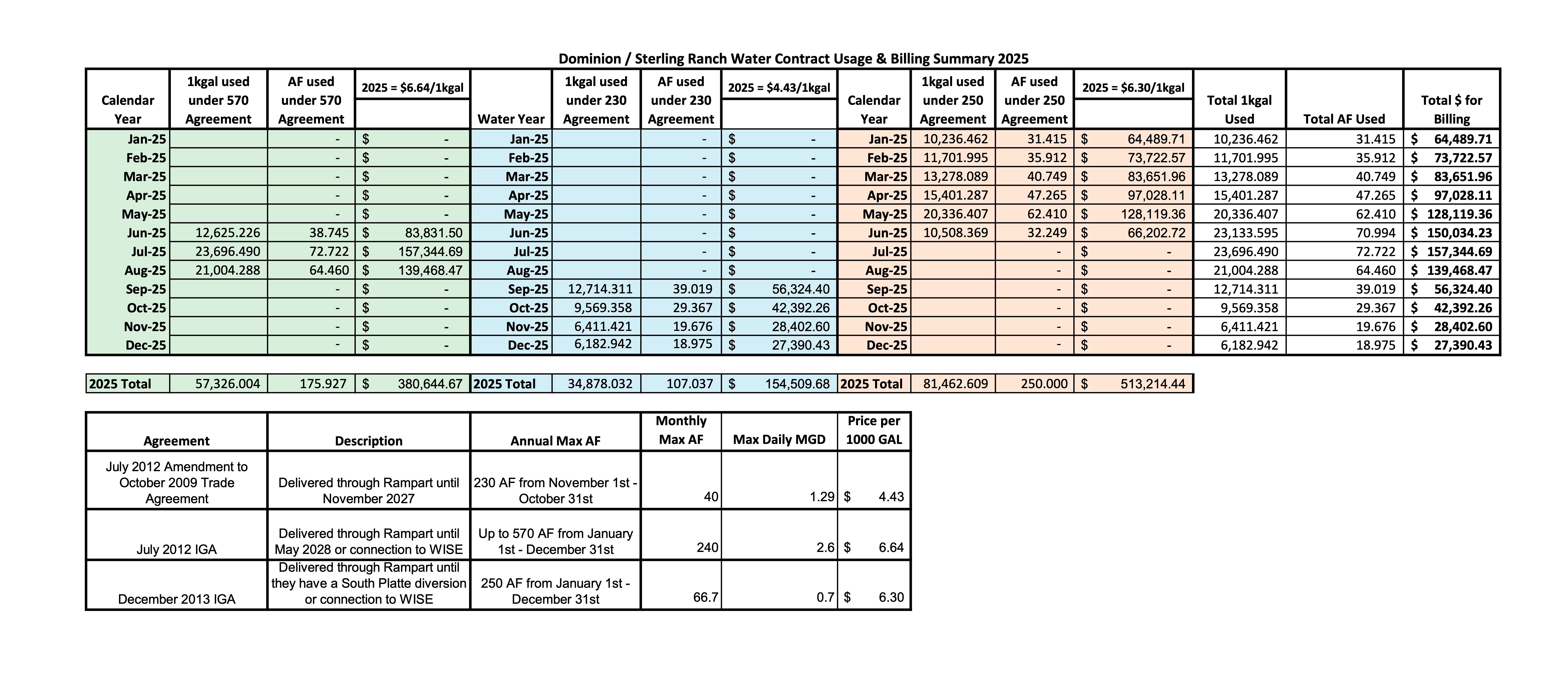
A note on the methodology: the Aurora Water figures represent wholesale delivery to Dominion, not metered end-use at the home level. System losses, construction water use, and any water delivered to non-residential Sterling Ranch customers sit between those two numbers. The developer-provided home sales figure, while plausible, is not an independently verified utility count; in any event it does not appear that Sterling Ranch is wildly over its water usage targets.
The More Pressing Question: Where Are the Expected New Homes?
The finding on water efficiency, however, is not the most consequential number in Dominion’s 2025 financial filings. That distinction belongs to a line item that received no public attention: tap fees.

Tap fees are one-time charges collected by Dominion each time a new home connects to the water system. They are, in effect, a direct measure of how many new homes were built and hooked up in a given year. Dominion’s 2026 budget — filed with Douglas County and the Colorado Division of Local Government as part of the district’s 2025 Annual Report — shows that Dominion collected approximately $8.3 million in Sterling Ranch water tap fees in 2025.
The budget for that year had projected $13.6 million.
That is a $5.3 million shortfall — a 39 percent miss against the district’s own projection. Sewer tap fees tell the same story: budgeted at $3.5 million, actual collections came in at roughly $1.85 million.
Combined, Dominion collected approximately $7.1 million less in new-connection tap fees in 2025 than it had planned. It is a direct measure of how many fewer homes were built and connected to the water system than the district anticipated.
Why That Shortfall Matters Beyond One Year’s Budget
To understand why a water district’s tap fee shortfall has consequences beyond its own balance sheet, you need to understand how Sterling Ranch’s infrastructure was financed — and who is on the hook if the plan does not work.
As the Lantern previously reported, Colorado’s metro district structure allows developers to finance public infrastructure — roads, water lines, sewer systems — through bonds repaid by future homeowners through property taxes. Sterling Ranch Development currently controls the metro district board, sets the debt, and issues the bonds. Residents inherit both the infrastructure and the obligation to repay it.
Sterling Ranch’s financial architecture goes further. Dominion Water & Sanitation District is not just the water provider for Sterling Ranch — it is a developer-controlled entity carrying $266 million in bond obligations through 2052, at interest rates above 5 percent. Annual debt service on those bonds alone is projected at approximately $9.9 million per year through 2052. On top of that sit three additional promissory notes, totaling more than $57 million in principal, bearing interest rates of 6.5 to 7.5 percent.
Dominion funds this debt primarily through tap fees on new homes and service fees from existing ones. It does not levy a property tax — its own 2025 Annual Report budget resolution states explicitly that “the District does not have the legal ability to certify a mill levy under its Service Plan.”
The implication is that Dominion’s ability to service its debt depends on Sterling Ranch continuing to build homes at or above the pace the district’s budget assumes. When construction lags — as the 2025 tap fee figures indicate it did — the financial cushion narrows.
The 2026 budget projects water tap fee revenue of $14.9 million, an 80 percent increase over 2025 actual collections. Whether that rebound materializes depends on whether new construction accelerates substantially from last year’s pace. Property tax payments and debt obligations do not wait on construction delays.
The Structural Pattern
This is not a problem unique to Sterling Ranch. The Lantern has documented the same basic architecture across Douglas County: developer-controlled special districts that finance infrastructure through debt, then depend on continued construction to service it. When growth slows, the pressure on the debt plan builds quickly. Parry Park Water and Sanitation District’s current high water rates are a cautionary tale about how residents pay the price when neighborhoods fail to achieve their buildout targets.
What distinguishes Sterling Ranch is scale and the added complexity of water. Dominion is simultaneously a water utility navigating state efficiency scrutiny, a bond issuer carrying more than $250 million dollars in debt, and an entity whose board is controlled by the same family developing the land it serves.
The Douglas County Commissioners approved Sterling Ranch to build more homes in part based on per-home water efficiency projections. Those projections are built on data that Dominion — controlled by Sterling Ranch’s developers — is responsible for tracking and reporting.
The 2025 water delivery data, at face value, suggests the efficiency model is working. But the same year’s financial data raises a different question: if home construction continues to run below projections, how long can a debt structure that is dependent on growth work?
Sources & Suggested Reading
Aurora Water / Dominion Water Contract Usage & Billing Summary 2025
Dominion Water & Sanitation District 2025 Annual Information Report
“Following The Water: How Douglas County Relies On Water It Does Not Control” — The Douglas County Lantern, January 2026.
“The Meadows of Castle Rock: $454 Million in Debt” — The Douglas County Lantern, April 2026.
Colorado Department of Natural Resources Letter to Sterling Ranch, January 2026.
“Sterling Ranch, master-planned community in Douglas County, CO, nears 3,000 homes sold” — Denver Business Journal, January 2026.
“Community split on Sterling Ranch rezoning amendment” — Douglas County News-Press / Castle Rock News-Press, February 2026.
More excellent reporting.
And I can't help but wonder where Aurora gets all its water.
I lived in Ponderosa Hills when it was fighting high density development of the 1000 acres just north of it across Inspiration Dr. The developers kept getting shot down by either residents objecting, since it violated the county's "master plan", or because the housing market would turn soft and their profits no longer assured.
Until some clever attorney figured out if the City of Aurora simply annexed the land, the developer could flip off local residents and Aurora would get the water rights.
And of course the very expensive highly touted "master plan" was all for show to residents who pay the county commissioners salaries, because it had no legal teeth.
I toured Sterling Ranch on a Water Education Colorado field trip when it was just getting started. The developer promised us that it would not have piped water; just what it could save "from the sky." His projections were obviously wrong.
Even if Sterling Ranch is not built out, the homeowners are going to have to shoulder the cost of the Dominion Water more and more.