
Residents Question Management of Perry Park Water
Rising costs, radium mitigation, and staffing issues

In recent months, residents of Perry Park, near Larkspur, have expressed growing concerns about their rapidly increasing water bills — and their concerns about water quality are even more well-established.
The typical monthly meeting of Perry Park Water and Sanitation District (PPWSD) is quiet and uneventful, including only Board Directors and staff. But the District’s most recent meeting on March 18th swelled to nearly 40 in-person and online attendees and lasted nearly three hours.
With a town hall feel, the meeting included extensive opportunities for attendee questions and comments throughout. This led to some tense exchanges, not only between Directors and residents but even between the attendees.
Concerns about Cost
New PPWSD fees have increased bimonthly water and sanitations bills by a total of $137 for residents who use both water and sewer services. According to former PPWSD Director Jim Maras, the average total water bill for Perry Park residents was around $150 every other month in 2010. Currently residents’ bimonthly bills run around $425 — before water and sewer rates are added. Use of water and sewer only adds to that base cost - and rates for both water and sewer increased on March 18th.
Concerns about Quality
In late 2024, the District discovered radium levels more than twice the EPA’s acceptable standard. Levels have since returned to compliance with the EPA’s standards.
One resident at the March 18th meeting voiced ongoing concerns about brown water. Board Treasurer, Brian Arthurs, acting as a spokesperson for the Board, responded to an inquiry about that concern:
“Regarding the rare occurrence of ‘discolored water,’ we encourage residents to contact the District office directly for an investigation into their specific service line. The district has never experienced a water quality violation.”
About Perry Park Water and Sanitation District
Due west of Larkspur, PPWSD is a special district serving residents of Perry Park and surrounding areas of unincorporated Douglas County. The nearby Town of Larkspur has its own separate water and sewer system. The most recent version of the District’s Water and Sewer Master Plan is dated April 2016.
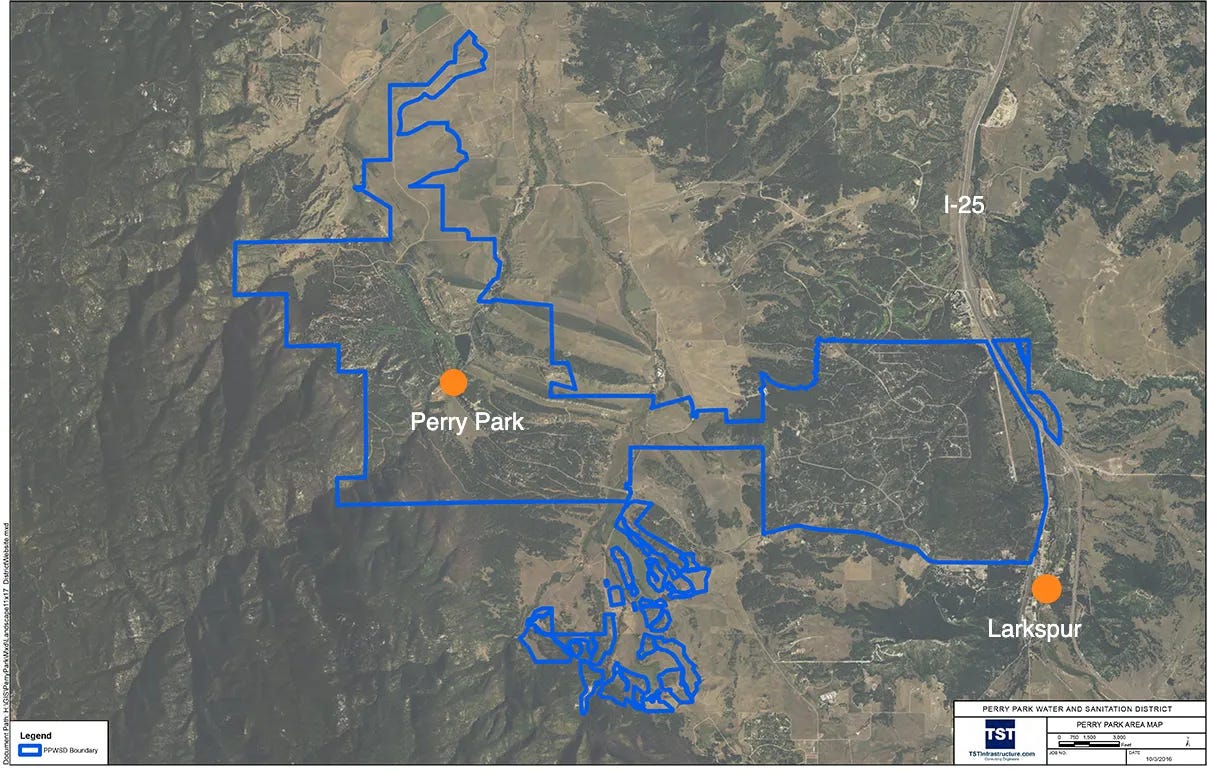
Established as a special district in the late 1960’s, PPWSD is a nonprofit government entity with an elected board of directors. The elected Directors are required to be registered to vote and permanently reside or own property in the District. According to the District’s website, Directors are elected for 4-year terms and can serve up to two consecutive terms.
The District’s website, lists the following Board Directors:
Gary Peterson, President
Tony Lucas, Vice President
Brian Arthurs, Treasurer
Julia McCusker, Director
The District’s board members are essentially volunteers. Paid a $100 stipend per monthly meeting, they oversee the work of the District Manager, Diana Miller, who has been conducting the daily management of the District full-time for decades. However, residents are concerned about the District Manager’s engagement in the role, and the Board’s responsiveness to those questions was one reason for the March 6th resignation of former Director Jim Maras.
Radium mitigation fees
Most groundwater in Douglas County contains some level of the radioactive element radium. Naturally occurring uranium and radium are common in the rock and soil across much of Colorado, and those elements leach into nearby groundwater. Perry Park’s groundwater sources contain naturally occurring radium at levels that have historically remained within EPA guidelines, despite the 2024 episode. However, Board Vice President Tony Lucas clarified in the March 18th meeting that as the District’s non-renewable aquifer water levels are decreasing, the concentration of radium in the remaining groundwater will naturally increase.
In July 2025, the District implemented a $2.5 million radium mitigation project and a $92 bimonthly ($46 per month) Radium Water Treatment Plant Upgrade Fee to cover the cost. Director Arthurs clarified that the $2.5 million reflects the cost of essential infrastructure upgrades. The fee is for those infrastructure construction costs and is expected to terminate in 2028. According to Arthurs, “Once the facility is constructed, any ongoing maintenance will be classified as a standard operational expense and folded into the base water rate.”
Fee and Rate Increases
At the March 18th meeting, Board Directors discussed and approved a new bimonthly Sewer Capital Fee of $45 ($22.50 per month). The Sewer Capital Fee has been created to help offset the costs of an $8.25 million loan with a 20-year term for capital improvements According to Arthurs, this fee has no expiration date. It is only billed to customers who use the District’s centralized sewer system, as some residents on the water system maintain their own septic systems.
The total cost of the upgrades is estimated at $9.25 million. Director Arthurs explained that the District is expecting to fund costs exceeding the loan amount (an estimated $1 million) with cash, and added, “We are moving quickly to avoid further project delays and cost escalations.”
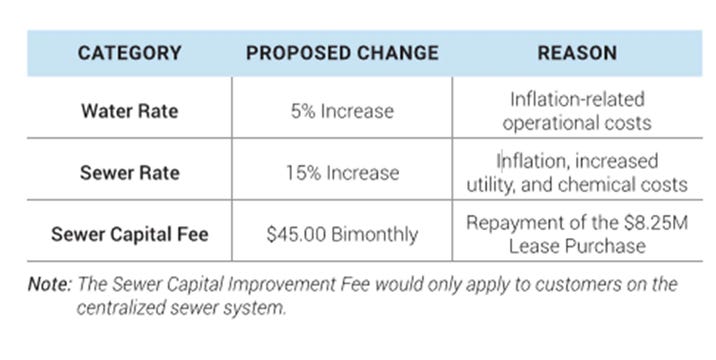
To ensure that new customers pay their fair share of the improvement costs of the District, Directors voted unanimously in November 2025 to increase tap and development fees by 2.8% for water service and by a whopping 56.1% for sewer service. In addition to those fee increases, Directors approved rate increases on March 18th of 5% on water rates and 15% on sewer rates.
One meeting attendee asked why rate increases are happening again so soon when rates were just increased last summer. In response, Director Tony Lucas clarified that the District is nonprofit, essentially owned by the residents of Perry Park, and the District is setting rates at a level necessary to keep the water system running.
Aging infrastructure and a small customer base
The overarching problem for Perry Park Water and Sanitation is not whether there is enough water. The District owns senior water rights to nearly twice as much water as it currently uses. Those water rights have an estimated value of $30-40 million, according to Maras.
The problem is money. Aging infrastructure is requiring updates and repair all at the same time — and the cost for improvements is being spread across a small number of existing users. The system’s original infrastructure was built in the 1960’s and 1970’s with the total buildout expectation of 3,400 users. Half a century later, the District serves less that half that number — only about 1,600 for water service and 1,300 for sewer service -- that places an even higher cost burden on those existing users.
The costs keep mounting. Already juggling costs for radium mitigation and wastewater treatment upgrades, the District is also in the early stages of a $1.5 million water meter upgrade. Director Arthurs explained, “The $1.5 million investment in Smart Meters is critical for addressing water loss caused by aging, inaccurate meters.”
Even though Perry Park’s water rights could provide enough renewable water to nearly replace the community’s groundwater supply, Director Lucas quoted a cost of $6 million in upgrades to the water treatment plant before the District would be able to use all of its available renewable water. Actual costs could run much higher.
The District has explored two alternatives that could relieve some of the cost burdens from Perry Park residents. As “a first step toward a more collaborative relationship” with nearby Castle Rock, the Board is exploring the possibility of leasing excess renewable water to the town, which relies primarily on non-renewable groundwater. Directors estimate that arrangement would generate, at most, a few hundred thousand dollars in revenue. The District has also pursued state and federal grants, including two requests to Rep. Lauren Boebert’s office.
Questions about professional management
Several attendees at the March 18th meeting voiced concerns about the performance of District Manager Diana Miller. According to Former Director Jim Maras, the District Manager has decades of experience working in the District, but after receiving Board permission to work from home two days per week due to a health situation, she has recently been out of the office most if not all days for several weeks. Maras notes that the District has short-term and long-term disability benefits as well as Family and Medical Leave Act benefits available to help employees who experience extended health issues.
Maras alleges that the District Manager has been collecting full pay and benefits while the volunteer Board has tried to take over the professional management of the District due to her absence. He says contract negotiations and ongoing management of contractors have been compromised and points to examples of improper delegation of duties as clear issues. Maras points to the Board’s unwillingness to “take prudent action and do what’s right for the District” as the primary reason for his resignation.
Several attendees at the March 18th meeting voiced concerns about the management of the District. In response, Director Lucas noted that board members had met in executive session with legal counsel and were advised against commenting on the current situation, because it is a personnel issue, but that the board is working toward a resolution. The District’s website shows three executive sessions — on February 26th, March 5th, March 6th (the date of resignation for former Director Maras) — between the Board’s February 18th and March 18th public meetings and an additional executive session on March 24th. Minutes from those meetings confirm that the Board has been discussing delegation of duties, personnel issues related to the District Manager, and Colorado Open Meeting Laws.
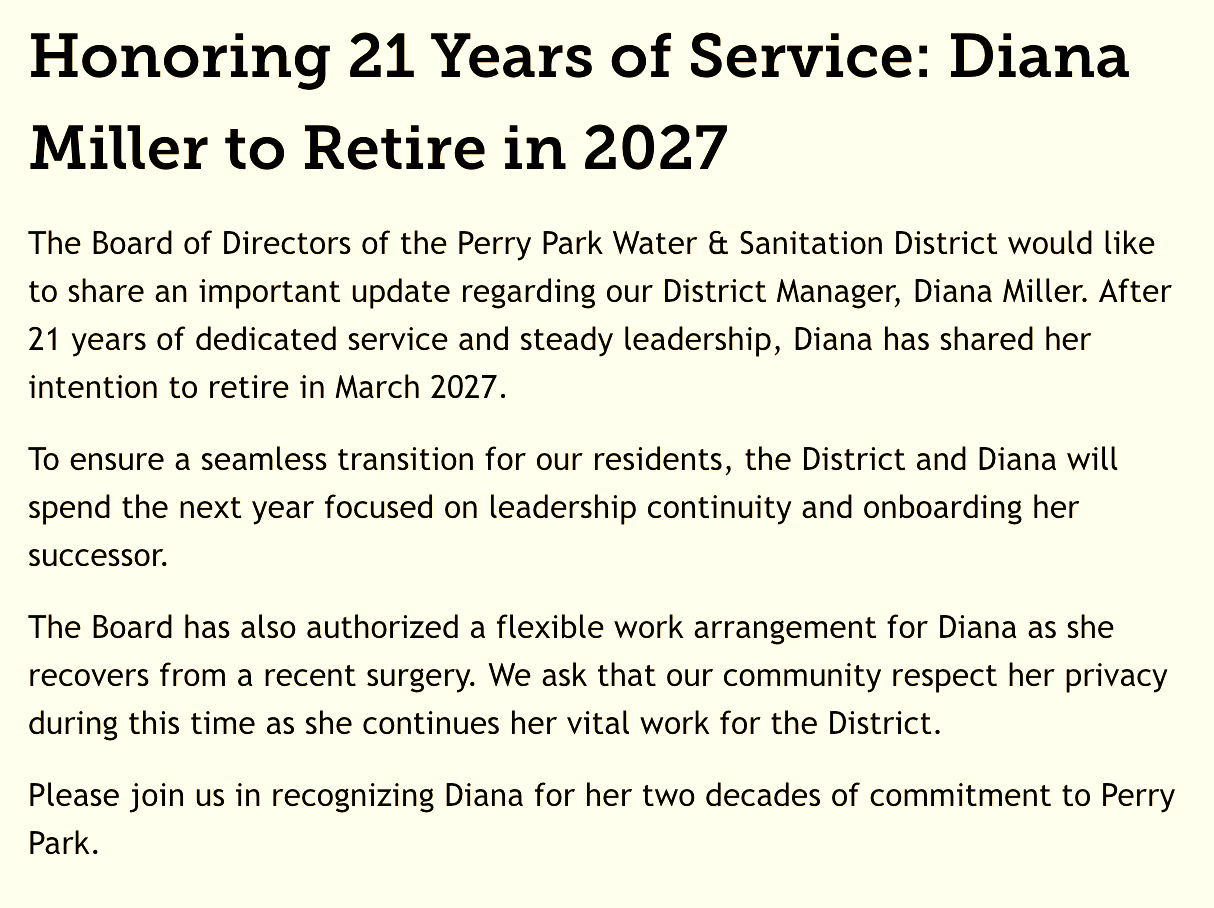
In recent days, a new message has appeared on the District’s website, announcing the March 2027 retirement of District Manager, Diana Miller, and efforts to ensure a seamless transition to her successor.
Questions about board governance
Board governance is also a matter of contention according to Maras, who believes the board could benefit from a requirement for Directors to engage in board training — he noted that the Special Districts Association of Colorado and the National Rural Water Association both offer board training sessions, but that the current board has not participated in formal board training.
In an apparent effort to allow ample opportunity for attendee questions and comments, the March 18th board meeting went off-agenda several times. Rules of order were flexible in some board discussions, and one specific comment from a Director raised questions about whether the Board is fully informed on decisions before they take a vote. In discussions of contracts , board members revealed confusion about change orders. One Director commented about an already-approved change order, saying, “We voted in favor of it, but I don’t understand it.”
One resident, Aaron Mathewson, detailed the questions around governance and operations that he planned to submit in a CORA (Colorado Open Records Act) request, and Directors tried to answer those concerns verbally in the public meeting with little success. Mathewson has been leading efforts to inform and engage residents in the area about water quality, fee increases, and board governance over the course of several months through Facebook posts and community meetings. We reached out to Mathewson for comment but did not receive a response. Another resident expressed appreciation for the efforts and positive intent of board directors, concluding, “We need good management, not good intention.”
What’s Next?
The Board has a 60-day window to fill a vacant seat. Perry Park Water and Sanitation District meets again on April 15th at 2 p.m. at 5676 W. Red Rock Drive Larkspur, Colorado. Agenda, packet, and remote attendance information can be found here when they are posted.
Related Reading
Perry Park Water and Sanitation District website
Concerns rise over record high radium levels in Perry Park water (9News, October 17, 2024)
Larkspur Sentinel, February 2026 (page 13)
I hope they reach a deal with Castle Rock. Otherwise, they're headed for disaster owing to the infrastructure they need to build.