Metro Districts Drive Big Tax Bills in Douglas County
A look at the dozens of special government districts paying investors with tax dollars
If you live in a master-planned neighborhood in Douglas County, the largest single line on your property tax bill probably isn’t the county. It isn’t the school district either. It is, in many cases, a metropolitan district that you have likely never voted for, that was created before your home was built, and whose original board members were the developer and their employees.
Across Colorado, there are nearly 2,500 metropolitan districts. Douglas County, where master-planned development has exploded the population from roughly 60,000 in 1990 to more than 380,000 today, is one of the most metro-district-dense counties in the country. Some of those districts are well-run, low-tax local governments that quietly deliver parks and trails for a fraction of what a city would charge. Others have authorized more than a billion dollars in debt that residents will be paying off long after their grandchildren are homeowners.
This is a rundown of how Colorado metro districts work, what they actually do for the communities of Douglas County, and where the model has produced both its biggest successes and significant fiscal disasters.
What A Metro District Actually Is
A metropolitan district is a quasi-municipal local government authorized under state law. They are created by petition to a county or municipality, governed by a service plan, and run by an elected board of directors. It can issue tax-exempt municipal bonds, levy a property tax on every parcel inside its boundaries, and operate public infrastructure — streets, water and sewer lines, parks, trails, recreation centers, and in some cases security and covenant enforcement.
The development case for metro districts is straightforward. New subdivisions need infrastructure before homes exist, and infrastructure is expensive. The Colorado Association of Home Builders estimates that paying for it up front would add $30,000 to $40,000 to every home. A metro district lets the developer borrow against the future tax base, build the infrastructure, and pass the cost to the homeowners who use it through a long-term property tax. In theory, growth pays its own way and home prices stay lower while property taxes on new homes subsidize the development.
A mill levy is the unit of measure. One mill equals $1 of tax for every $1,000 of assessed value. Assessed value and appraised value (what you might sell your home for) are not the same dollar amount. On a Douglas County home with an actual value of $700,000, one mill comes out to about $47 per year. A 50-mill metro district levy on that same home is about $2,345 per year — every year.
That math is where the criticism starts.
The Structural Problem
When a metro district is first organized, almost no one lives there. The developer and their associates often hold every seat on the board because they are the only eligible electors — they own the dirt. From those seats, they set the debt ceiling, approve bonds, negotiate the bond terms, hire the lawyers, and in many cases buy the bonds themselves through affiliated entities. The interest payments on those bonds are then secured by the most reliable collateral imaginable: a property tax on a piece of land a future homeowner will pay every year for decades.
State Sen. Lisa Frizell, a Castle Rock Republican who lives in The Meadows, has said publicly she has “seen a lot of kind of shady dealings by metro districts over the years.” John Henderson, who co-founded Coloradans for Metro District Reform, has put it more plainly, calling the structure “a lifetime annuity that pays out, guaranteed by the most secure source of revenue you can imagine — taxes.”
State Sen. Mike Weissman has said the authorized debt of Colorado’s metro districts now exceeds $1 trillion. About 100 new metro districts are approved every year. Most of the homeowners inside them have no idea what their service plan says, who their bondholder is, or how long they will be paying.
Three reform efforts at the state Capitol — most recently HB 25-1079, which would have brought special district board members under the Independent Ethics Commission — have died in three consecutive legislative sessions, killed in the Senate after passing the House.
Highlands Ranch: The Model When It Works
Highlands Ranch is the example metro district reformers point to when they want to argue the structure can produce good outcomes. Founded in 1981 on a 22,000-acre cattle ranch, the community is now home to roughly 100,000 residents. Because Highlands Ranch is unincorporated (no city council or mayor), the Highlands Ranch Metro District is the local government that actually shows up in the daily lives of residents.
Its 2024 mill levy is 10.110 mills — reduced from 11.205 mills the year before in response to the surge in residential property values, and well below the voter-authorized cap of 12.750 mills. For a $700,000 home, that works out to roughly $475 per year. For that, residents get 26 public parks, four dog parks, the parkway landscaping that defines the look of the community, street and infrastructure services, and operational support for the 8,200-acre Backcountry Wilderness Area, a conservation property managed jointly with the Highlands Ranch Community Association.
A few things explain why Highlands Ranch worked. The original developer, Mission Viejo Company and its successors, built infrastructure before the metro district structure became a vehicle for massive bond issuance. The community transitioned to resident-controlled boards relatively quickly. Voters capped the mill levy. And the district kept its scope to operations and parks rather than chasing the kind of compounding-interest debt structures that would later define the worst metro district stories in the county. The Centennial Water and Sanitation District (recently renamed Highlands Ranch Water & Sanitation) has been similarly disciplined, building real surface water and reuse infrastructure rather than relying entirely on the depleting Denver Basin aquifers.
There are legitimate criticisms of Highlands Ranch — Backcountry development and the relationship between the District and the Highlands Ranch Community Association — but the district’s tax structure is not comparatively and objectively outstanding. Whatever else can be said, Highlands Ranch homeowners are getting a remarkable amount of public infrastructure for a fraction of what other Douglas County residents pay in taxes.
Highlands Ranch is the comparison case for everything that follows.
The Meadows and Founders Village: Living With Restructured Debt from the Reagan Administration
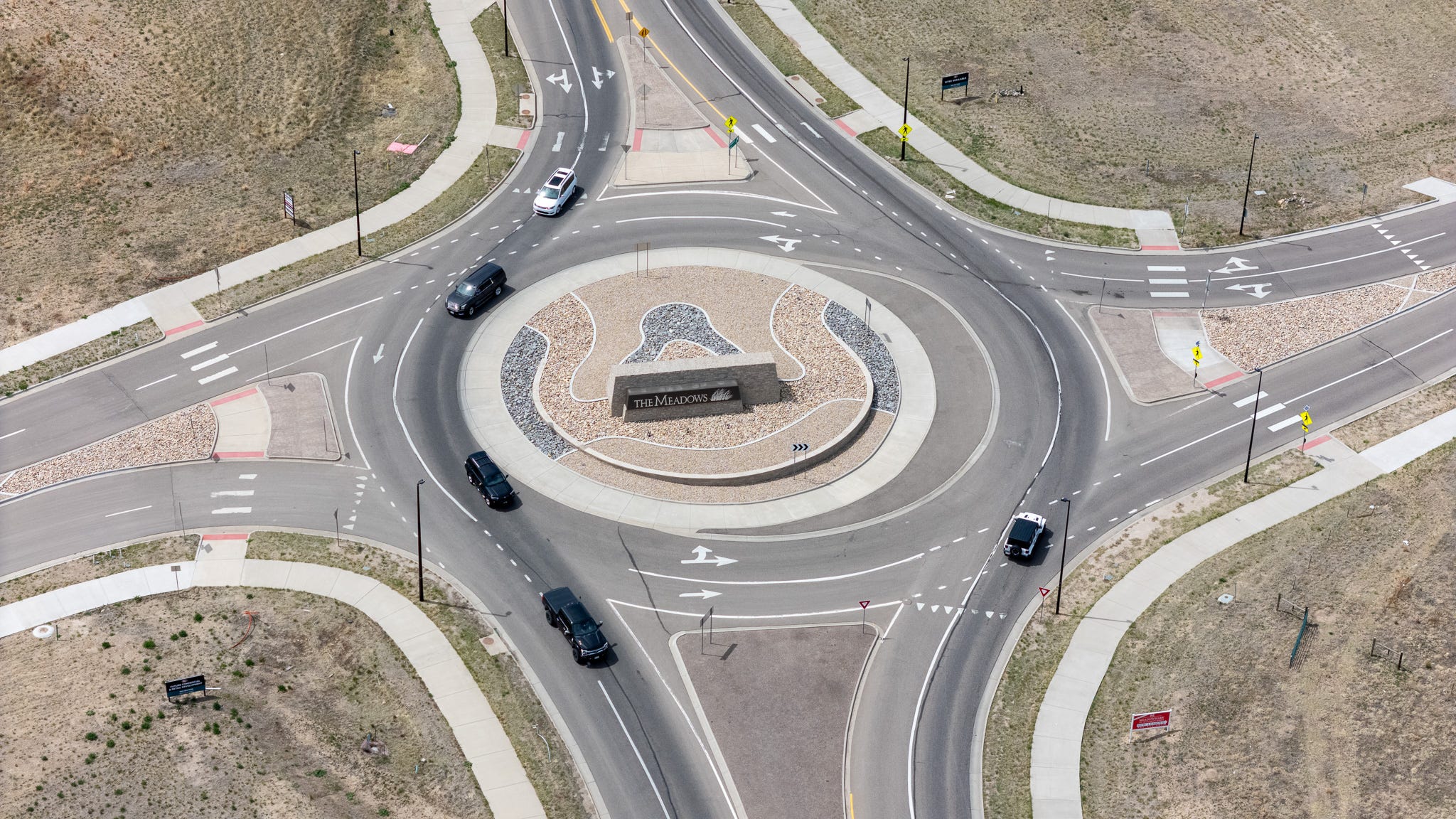
On the other end of the county, in northwest Castle Rock, sits The Meadows with roughly 7,500 homes. About a third of every property tax bill in the Meadows is servicing a debt that began as $57 million in infrastructure bonds in the 1980s and has, by the most recent accounting, grown to $454 million.
Not one dollar of original principal has been paid down in 35 years.
The mechanics of that problem are simple. The original 1986 bonds were restructured in 1991 and again in 1993. The October 1993 plan was approved by the Town of Castle Rock with a a target 30-year payoff. Two months later, in December 1993, the seven district boards — then controlled by individuals affiliated with the developer and the bondholders — entered into a separate agreement that converted the bonds into compounding-interest debt with options for no or partial payment of interest as it accrued. Castle Rock has stated, when shown the December 1993 documents by Castle Rock resident Jim Garcia, that it had not previously seen them.
Meadows homeowners have paid more than $200 million in metro district taxes since the late 1980s. The debt is bigger now than when they started. The bondholder, an entity called Castle Rock Bonds LLC, is reportedly seeking around $600 million in total tax revenue before the debt will be discharged.
The 35-mill rate on each of the seven Meadows districts is fixed and cannot be increased — a real protection for current homeowners. But the rate is also why developers across Colorado are now seeking 70-to-95-mill authorizations on new developments rather than building under Meadows-style fixed caps. After a CBS Colorado investigation in February 2025, Meadows residents organized, ran for the boards, and in May 2025 took control of five of the seven districts. The exception was District 4, the master district controlling the bond debt, where residents who tried to run were told by metro district attorneys that their properties were excluded from district boundaries and they were therefore ineligible. The newly resident-controlled boards have retained counsel and are reviewing options.
[The original version of this article stated debt owed by The Meadows would be due in full in June 2029, a corrected and clarified explanation is below]
Compounding interest on the 1993-restructured bonds is set to continue accruing through June 1, 2029. At that point, interest will stop accruing, but this is not a lump-sum payment trigger. Instead, property tax collections will continue indefinitely at the same mill levy rate—35 mills—that has been in place for the past 40 years. There will be no change to homeowner taxes on that date, but under the current bond structure, tax collections will never cease. The Meadows bonds were restructured in 1993 to collect tax revenue for roughly 100 years—meaning the debt and the taxes funding it will outlast current homeowners.
Founders Village
The other Castle Rock community living with restructured 1980s bond debt is Founders Village, governed by the Founders Village Metropolitan District and Villages at Castle Rock Metropolitan District No. 4. The district’s 2024 mill levy is 94.56 mills — the highest single metro district levy in Douglas County, and roughly nine times what Highlands Ranch residents pay. For a $700,000 Founders Village home, that one line on the tax bill is approximately $4,440 per year. After all other authorities are added in (e.g. schools), the district’s combined mill levy clears 164 mills.
The mill levy for Founders Village is computed annually under terms set by the 1991 Chapter 9 bankruptcy plan, which restructured the original 1986 bonds into a 40-year obligation. According to the district’s own public communications, the bond debt is on track to be discharged in 2031, after which the district intends to adopt a significantly lower mill levy, and residents would see a meaningful drop in their overall property taxes in 2032. That 40-year clock is the kind of dismal timeline Founders Village got stuck with in bankruptcy court decades ago; now that kind of timeline is the opening gambit for metro districts like Dawson Trails and Sterling Ranch.
Castle Pines North: Bankruptcy, Water, and Surrender
Castle Pines North Metropolitan District, established in 1984 to serve what is now part of the City of Castle Pines, filed Chapter 9 bankruptcy in 1991. After an early-1990s housing collapse left the district unable to service its debt, the district restructured under bankruptcy supervision and spent the next two decades aggressively paying their balance. Then a different problem arrived: the Denver Basin aquifers the district relied on were drawing down. Residents rejected a $49 million bond proposal in 2018 to fund renewable water infrastructure (which would have come with a $103 million repayment cost), with about 70% voting no.
In 2023, the district transferred parks, recreation, open space, and stormwater responsibilities to the City of Castle Pines under an intergovernmental agreement, dropping its mill levy from 19 to 7 mills. Today the district’s 2024 mill levy is 3.5 mills — it remains the wholesale water and wastewater provider for the area but no longer carries the parks burden.
The district is now stable. But it took 30 years of aggressive payment, a bankruptcy court, a water crisis, and eventual transferring responsibilities to the City of Castle Pines - which did not exist when the metro district was created - to arrive at something that looks like a solution.
Sterling Ranch: A New District with Old Conflicts
Sterling Ranch, the master-planned community in northwest Douglas County between Roxborough and Chatfield Reservoir, is structured under a Community Authority Board governing seven numbered metro districts. Its mill levies are some of the highest in the county for active, new construction. Sterling Ranch Colorado Metropolitan District No. 3 alone certified 33.284 mills for general operations and 62.238 mills for debt service in its most recent budget cycle — a combined 95.5 mills, before any other taxing authority is added. The marketing material describes this as the equivalent of HOA dues. The math says these levies average about $4,500 per year on a typical Sterling Ranch home, before adding other taxes for schools, the county, and other districts like fire departments.
Douglas County approved Sterling Ranch on the strength of unusually low projected per-home water use — about 0.18 acre-feet per year, well below the typical suburban 0.25-to-0.50 acre-feet. Those projections are monitored by Dominion Water and Sanitation District, which is itself controlled by the Sterling Ranch Development Company. The same people who benefit financially from approving more homes also run the government entity that monitors whether the homes can be supported by the water supply they oversee.
In a January 2026 letter, Colorado’s State Engineer wrote to Sterling Ranch saying its application to add 4,000 more units “did not provide required information” and that, based on what was submitted, “it is unclear if the… demands associated with the additional 4,000 units that are part of this Amendment will meet the 0.25 [acre-foot per year] limitation.” Aurora Water, which supplies Dominion Water through a long-term agreement, is now the primary upstream source for the Sterling Ranch development. The metro district’s financial structure only works if the new homes get built and start paying taxes. The availability of water increasingly determines whether the homes can be sustained.
Dawson Trails And The Next Generation of Metro Districts
If The Meadows is the cautionary tale of the 1980s and Sterling Ranch is the cautionary tale of the 2010s, the test of whether anything has been learned is now under construction at Dawson Trails.
Dawson Trails is a roughly 2,000-acre development on the south end of Castle Rock, anchored by an incoming Costco and a new Crystal Valley Parkway interchange on Interstate 25. The amended service plan, approved by the Town of Castle Rock on September 6, 2022, authorizes the Dawson Trails Metro Districts Nos. 1 through 7 to incur an aggregate $1,062,390,000 (call it $1 billion) in debt. The seven districts share a single mill levy number: each is currently levying 74.044 mills. That’s about 7 times what residents in Highlands Ranch pay. The Dawson Trails districts will serve 5,850 approved homes plus 3.2 million square feet of commercial space.
More than a billion dollars in authorized debt. Mill levies in the 70s. A 50-year debt-service window written into the service plan.
Interestingly, five mills per year are remitted to the town in any year debt service taxes are imposed, which gives the town a financial incentive to keep the Dawson Trails structure going. Castle Rock is more or less receiving a dividend for allowing Dawson Trails to exist.
Other newer districts are operating in the same range. Crowfoot Valley Ranch No. 2 sits at 80.47 mills. Canyons Metro District No. 2 at 71.73. Crystal Crossing, Solitude, and Lincoln Meadows are all in the 50s. These are the mill levies developers are now seeking and that the Board of County Commissioners and town councils are approving — two and three times what Highlands Ranch residents pay, and at the upper end of what The Meadows residents have been paying for four decades without any principal reduction.
Arguments For Reform Are Visible in the Data
Advocates for metro district reform want to see safeguards like 40-year bond term limits, debt mill levy caps, financial advisor certifications, and statutory transparency requirements.
This table lists selected Douglas County metropolitan districts, the city or unincorporated area they sit in, their 2024 collection-year mill levy, and a summary of the services they provide. It is not exhaustive, but it covers the largest residential master-planned communities and is a representative sample.
A few things stand out when the data are in one place. The lowest-mill districts in the county are the oldest, most resident-controlled ones with mature bond debt either paid off or close to it. The highest-mill districts in the county are either the 1986-era bond restructurings still working out from under their compounding interest, or the brand-new districts being approved with high debt and high taxes. The middle of the chart — mature suburban metro districts at 20 to 40 mills — is where the model arguably works as designed.
Buyers who do not understand which type of metro district they are buying into are at a real disadvantage. State law requires metro district disclosure on property transfers, but the disclosures are written by the industry, and most buyers never read past the dollar figure on the listing.
What the County and Town Governments Are Doing: Not Much
Douglas County’s Board of County Commissioners has reduced the county portion of the property tax bill in six of the last eight years — most recently delivering $37.8 million in tax relief by lowering the county mill levy by 3.679 mills. That is a real reduction, and it deserves to be reported as one. It is also a reduction on a portion of the bill that, in many of the affected neighborhoods, is roughly one-fifth the size of the metro district line directly above it.
The town councils of Castle Rock, Parker, Castle Pines, and Lone Tree are the bodies that approve service plans for new metro districts inside their boundaries. The Board of County Commissioners approves them in unincorporated areas. The Colorado Department of Local Affairs maintains a registry but exercises no operational oversight. State Sens. Frizell, Brooks, and Weissman have called for a performance audit of DOLA’s metro district oversight. The audit has not yet happened.
The Town of Castle Rock, when presented with the original December 1993 documents that materially altered the Meadows bond structure, responded by retaining outside counsel rather than substantively engaging with the more than 7,500 homeowners affected. It has not publicly explained its own oversight role during the intervening decades.
Questions We Need Answered
Who actually owns Castle Rock Bonds LLC, the entity collecting the interest payments from Meadows homeowners?
How many of the Dawson Trails bonds, when issued, will be purchased by entities affiliated with the developer Westside Investment Partners or its principals? (The same dynamic that produced The Meadows)
What is the County Commissioners’ standard for approving service plans in unincorporated Douglas County, and how does it compare to the published policies in Aurora and Colorado Springs that cap combined debt mill levies at 50 mills?
What happens to Sterling Ranch’s ability to service debt if it cannot build the homes it planned for due to a lack of water?
Sources & Suggested Reading
• Douglas County Assessor: 2024 Tax Districts and Mill Levies (PDF)
• Douglas County Clerk: Special District Public Notices Archive
• Colorado Department of Local Affairs — Special Districts Brief Review
• Highlands Ranch Metro District Lowers Mill Levy (Highlands Ranch Metro District news)
• Founders Village Metro District: Addressing Questions About Bond Debt (PDF)
• Castle Pines North Metropolitan District
• Castle Pines North history (Castle Pines Connection)
• Sterling Ranch Community Authority Board: Property Taxes
• Dawson Trails Metropolitan District Nos. 1–7 — Service Plan & HB25-1219 Information
• Coloradans for Metro District Reform
• Metro District Education Coalition: Knowledge Center
• CBS Colorado: The Meadows neighborhood metro district investigation
• Colorado Politics: Metro district reform bill bars developers from buying own bonds


Thanks for a well written deep dive into this subject. Every homeowner (or prospective homeowner) should read your article.
Fantastic article. Two notes:
1) Sterling Ranch metros all have those 95 mil numbers. Districts 2 and 3 have residents and both pay 95.
2) Another driver for the mil rate is if the developer can exert control over resident taxation *even after* the residents take control of the metro district boards via shady intergovernmental "agreements" where the developer agrees with himself to give himself indefinite taxation authority.