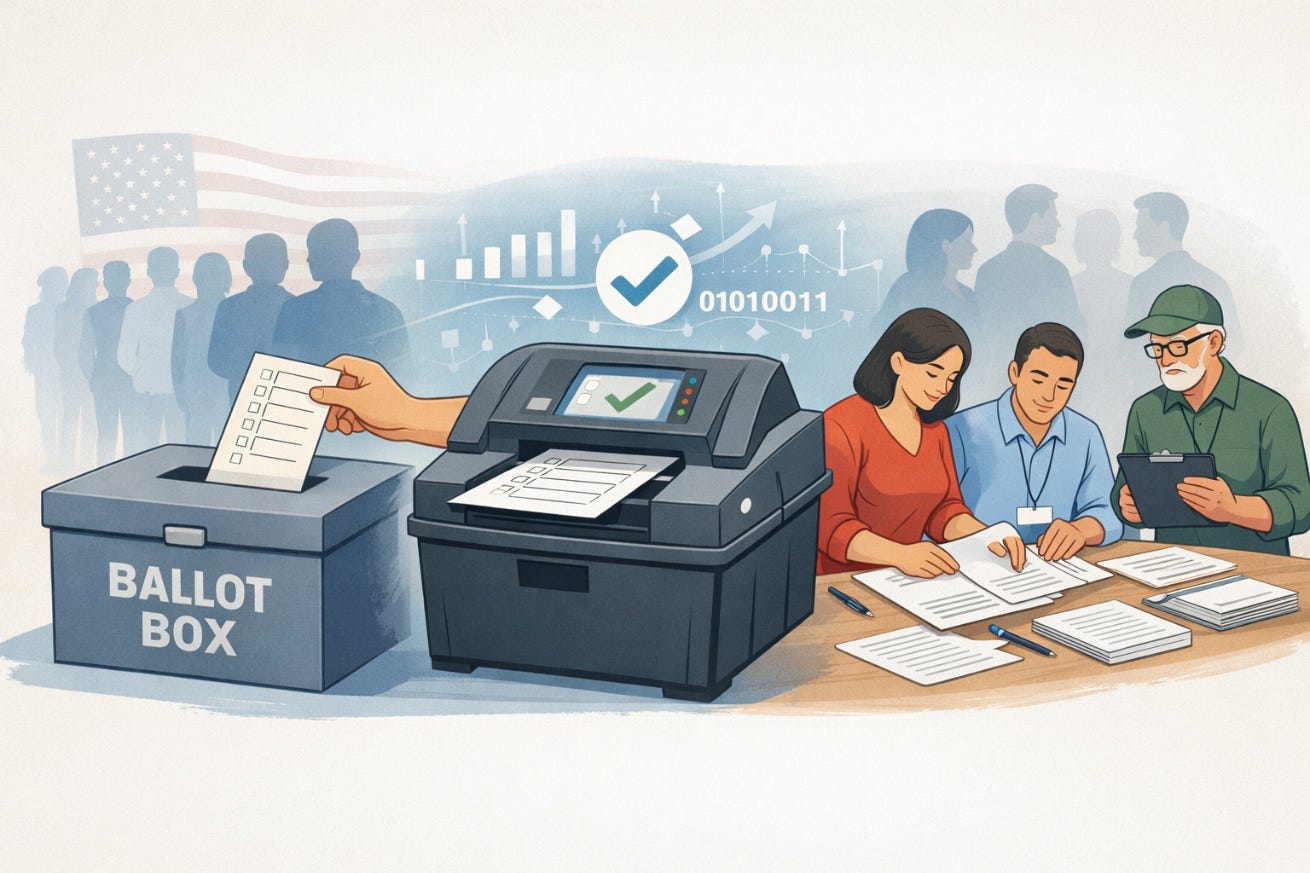
Hogan: What I Saw at the GOP State Assembly—and What It Taught Me About Election Accuracy
“A hot mess, in a dumpster fire, on a train wreck.”
That was the text message one of my fellow delegates showed me as we stood in line for nearly four hours waiting to get into the Colorado Republican State Assembly in Pueblo. I didn’t read about this online. I was there—as a returning delegate—and from the moment I arrived, it was clear something wasn’t right.
More than 2,000 delegates from across the state gathered to nominate candidates for the primary ballot. I arrived at 8:30 a.m. for a 9:00 start and found a line stretching roughly half a mile. Word filtered back that internet connectivity had failed, and the credentialing process—the system used to verify delegates—was being adjusted in real time.
Ironically, that raised an immediate question in my mind. Manual processes weren’t new. In fact, similar assemblies had used paper-based credentialing in the past without issue. Why the sudden dependence on a system that couldn’t function without connectivity?
Eventually, around 1:30 p.m., the assembly began.
Where Things Broke Down
For those unfamiliar, the assembly process starts with credentialing—verifying that each delegate is authorized to vote. Delegates present identification, receive credentials, and are processed into the system. That count becomes the baseline for how many votes should ultimately be cast.
Inside the venue, the process appeared orderly. Delegates voted using paper ballots, deposited into sealed containers, and monitored by volunteers and campaign observers.
But when votes were tallied, a problem emerged: the number of ballots exceeded the number of credentialed delegates. The number circulating among delegates was 87.
At first glance, that sounds alarming. But here’s an important distinction: discrepancies like this are not uncommon in large assemblies. They don’t automatically indicate fraud—they indicate a reconciliation problem.
In previous assemblies I attended, similar discrepancies were resolved by going back to paper records—signature logs or manual credentialing sheets—and verifying the count. In those cases, the issue wasn’t extra ballots. It was an undercount in credentialing.
That option didn’t exist here.
Because portions of the credentialing process relied on electronic scanning—and because some delegates who had technical issues were processed manually without being scanned—the system lacked a complete, auditable backup. When the discrepancy appeared, there was no reliable way to reconcile it in real time.
And that gets to the real crux of the issue.
The Real Issue: Voting Machines vs. Vote Counting
Much of today’s political debate centers on “machines,” but that term is often used too broadly.
There is a critical difference between:
Voting machines that record votes electronically without a paper trail, and
Technology used to count or process paper ballots
The concern is not the use of technology itself. In fact, technology—like optical scanners—can dramatically improve speed and consistency in counting.
The concern is auditability.
Systems that replace paper ballots or fail to produce a verifiable record make it difficult—or impossible—to independently confirm results. That’s why election experts across the political spectrum emphasize the importance of voter-verifiable paper ballots.
According to the Brennan Center for Justice, systems that rely on paper records allow for meaningful audits and recounts, while purely electronic systems without such records do noti.
Similarly, the National Conference of State Legislatures notes that post-election audits depend on physical ballots or records to verify outcomesii.
What happened at the assembly wasn’t a failure of “machines” in general—it was a failure to maintain a system that could be independently verified when something went wrong.
The Debate That Followed
A few days later, I listened to the Jeff & Bill Show on KNUS 710 AM, where gubernatorial candidate Maria Orms and a host discussed what had happened.
The conversation eventually turned to vote counting accuracy.
One claim suggested that hand-counted ballots are more accurate than machine tabulation. Another claimed that hand counting could be off by as much as 25 percent.
Both statements sounded authoritative. Both couldn’t be right.
So I went looking for the data.
The Real Problem: Defining “Accuracy”
What I found is that most debates about election accuracy are built on a misunderstanding: people are talking about different things.
“Accuracy” in elections can refer toiii:
Machine tabulation precision
Human counting reliability
Recount differences
Final certified outcomes after audits
Without clarifying the metric, statistics can easily be misinterpreted.
What the Data Actually Shows
Across multiple studies and election audits, a consistent pattern emergesiv:
Machine tabulation systems, especially optical scanners, are highly accurate under federal testing standards
Hand counting tends to introduce more variability at scale due to human factors
Recounts typically show small differences—often tenths of a percent—driven by interpretation, not systemic failure
Audits consistently confirm that final outcomes are accurate within very small margins
The takeaway is straightforward:
The system is not perfect—but it is designed to detect and correct imperfections.
How Election Accuracy Actually Works
Election integrity depends on layered safeguards:
Paper ballots create a verifiable record
Machines provide efficient counting
Audits verify results
Recounts resolve close contests
Accuracy doesn’t come from one step—it comes from the system checking itself.
In Pueblo, that redundancy broke down—not in the voting itself, but in the inability to verify credentialing when something went wrong.
Why This Matters Locally
For voters in Douglas County and across Colorado, confidence in elections matters as much as the mechanics themselves.
Even when discrepancies are explainable, visible confusion can erode trust. And when trust declines, participation often follows.
That’s not a partisan issue. It’s a civic one.
Why It Matters Even More to Gen Z and Young Voters
This issue carries particular weight for younger voters.
Gen Z has grown up in a world filled with competing narratives and constant information flow. They are more skeptical of institutions—and more likely to question systems they don’t fully understand.
In my recent book, The Next Greatest Generation: A Fatherly Conversation Between a Gen X Dad and the Men of Gen Z, I argue that rebuilding trust in institutions will be one of the defining challenges for this generation.
But trust requires clarity.
Election integrity isn’t just about whether votes are counted correctly—it’s about whether people believe they are.
Final Thought
The events in Pueblo were frustrating. Disorganized. At times, chaotic. But they were also instructive.
Because what felt like a “hot mess, in a dumpster fire, on a train wreck” wasn’t proof of a broken system.
It was a reminder of something more important: when systems fail, the ability to verify them matters more than the failure itself.
And next time, hopefully, we can do it without the four-hour line.
Dr. Jeff Hogan is a retired U.S. Air Force Lieutenant Colonel with more than three decades of experience in operations, analysis, and defense contracting. After his military career, he spent over a decade developing technical papers, proposals, and strategic assessments for Department of Defense programs. His background in systems analysis informs his writing on public policy, governance, and economic trends. A Colorado resident since 1990, he currently lives in Parker, Colorado.
Footnotes
i Brennan Center for Justice. “Voting Machines at Risk in 2022.”
https://www.brennancenter.org/our-work/research-reports/voting-machines-risk-2022
ii National Conference of State Legislatures, “Post-Election Audits,”
https://www.ncsl.org/elections-and-campaigns/post-election-audits
iii U.S. Election Assistance Commission, “Voluntary Voting System Guidelines,”
https://www.eac.gov/voting-equipment/voluntary-voting-system-guidelines and U.S. Election Assistance Commission, “Complete Logic and Accuracy Testing Manual,”
https://www.eac.gov/sites/default/files/eac_assets/1/28/Logic_and_Accuracy_Testing_Manual_Final_v1.4.pdf
iv Proceedings of the National Academy of Sciences, “Error rates in election audits for the 2020 U.S. election,”
https://www.pnas.org/doi/10.1073/pnas.2419633122 and Brennan Center for Justice, “Post-Election Audits: Restoring Trust in Elections,”
https://www.brennancenter.org/our-work/research-reports/post-election-audits-restoring-trust-elections


Interesting take on paper ballots. The Dems use electronic which are verifiable and more efficient. (Although there were system capacity issues this year)