


Most of us have heard that “public schools are funded through taxes” — but few have ever looked closely at what that actually means. When DCSD says it can’t afford competitive teacher salaries, or that programs have waitlists, what’s really going on?
DCSD at a glance: a nearly $1 billion operation
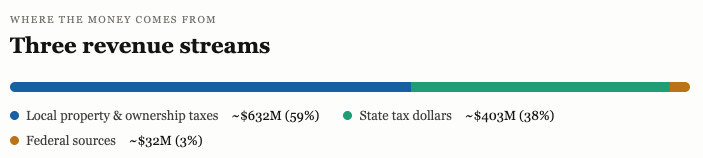
The Douglas County School District is Colorado’s third-largest, serving more than 61,000 students from preschool through twelfth grade. Its annual budget sits at $965 million.
Funding sources include:
local property and ownership taxes (~59%, or $631.8M)
state tax dollars (~38%, or $402.8M)
federal sources (~3%, or $31.5M) (Source: CDE Financial Transparency)
Local taxes carry the heaviest load, contributing nearly six in every ten dollars the district spends, or 59% of the total budget. State funding fills most of the gap while federal dollars, often earmarked for specific programs, represent a small slice.
Students Served: 61,000+
Annual Budget: $965M
Colorado Ranking: #3
Local funding tools: beyond local, state and federal funding: voter-approved dollars
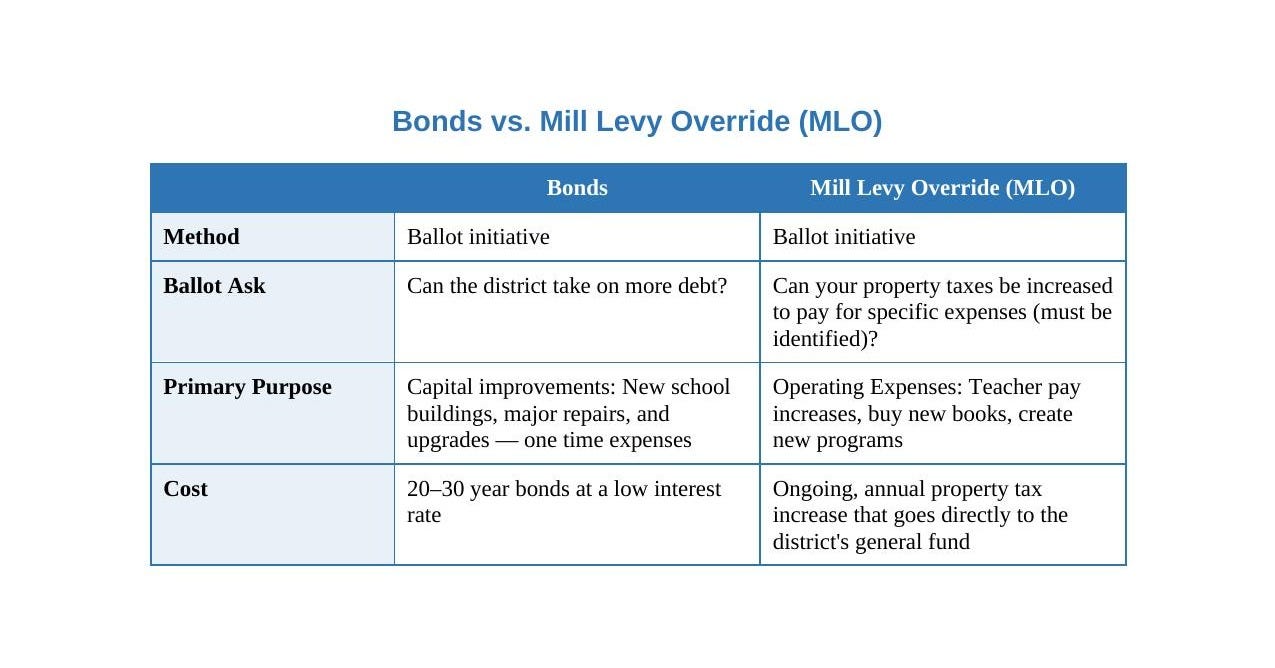
On top of state and federal funds, Douglas County voters can — and do — approve additional local revenue through two distinct mechanisms: mill levy overrides and bond measures. Understanding the difference matters, because they serve different purposes.
What are mill levy overrides and bond measures?
Mill Levy Overrides (MLOs) are voter-approved increases in property taxes that provide additional local revenue for ongoing expenses
operating expenses, such as staff salaries
benefits
classroom technology.
Bonds are voter-approved general obligation bonds — taxpayer-funded debt used solely for capital needs, such as:
constructing new schools
building repairs
technology upgrades.
Simply put: Bonds are for building, while Mill Levy Overrides are for operations.
If voters do not approve MLOs or bonds, then the school district must make do with the funding they receive from other sources.
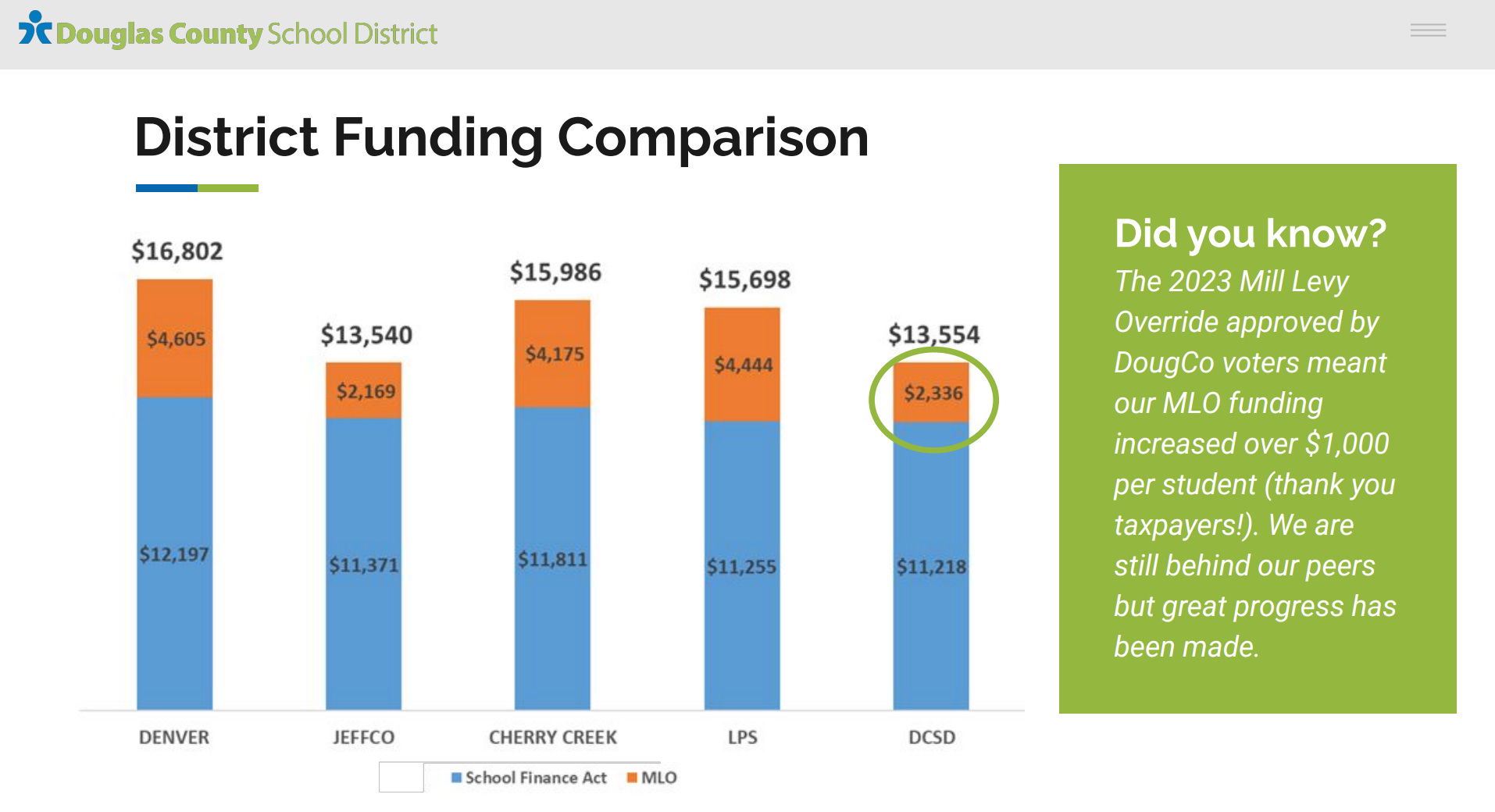
According to the Colorado Department of Education, Douglas County spends about $16,096 - $16,589 per student per year, against the $15,589 - $16,096 funding it receives.
This funding is:
About 1.4% lower than the state average
8.5% less than Cherry Creek
14.5% less than Denver
The same as Jefferson County
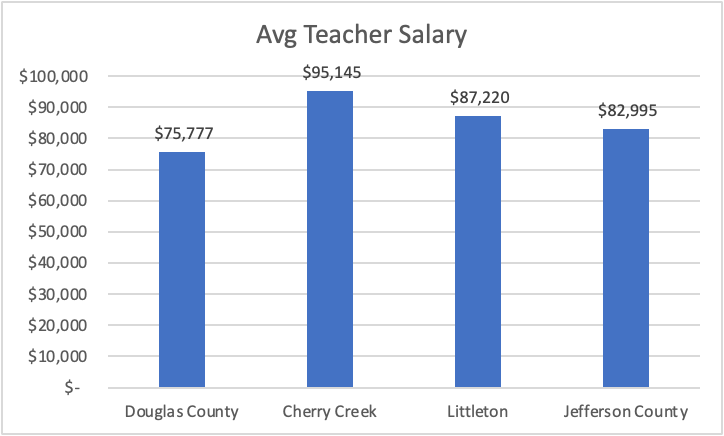
The per-pupil funding to spending gap has a real-world consequence: teacher pay. Despite a 9% increase in pay funded by the 2023 voter-approved mill levy override, Douglas County teacher salaries are still 7% below regional levels — a gap that has persisted for more than a decade. The district has consistently fallen behind neighboring Denver-area districts since roughly 2012, when the school board ended collective bargaining and froze negotiations.
The result has been elevated staff turnover between 19-20%, making it harder to maintain the experienced, stable teaching workforce that research consistently links to student outcomes. According to a study by the Stanford Center for Education Policy Analysis on the impact of teach turnover, “results indicate that students in grade-levels with higher turnover score lower in english, language, arts (ELA) and math, and that this effect is particularly strong in schools with more low-performing and black students. Moreover, the results suggest that there is a disruptive effect of turnover beyond changing the distribution in teacher quality.”
With the 2023 increase to teacher’s salaries, the District has seen turnover fall to about 13%.
The current funding sources of local property taxes, state tax dollars, and federal sources are designed to cover the majority of the schools operating expenses, but not capital improvements or building repairs. This is where a school district can get into budget trouble: not enough funding for maintenance to existing buildings and construction of new ones.
The recent history of DCSD funding requests
DCSD has gone to voters periodically over the past two decades, with mixed timing and results. Understanding that history helps explain the bind the district finds itself in today.
2006 Bond & MLO approved: Voters approved funding to manage district growth
2006 - 2018 NO Requests: No additional funding requests were made for more than a decade. During this period, capital improvement needs quietly accumulated - deferred maintenance, aging infrastructure, and growing enrollment pressure that the base funding formula couldn’t fully address.
2018 Bond approved: Bond measure approved to resume capital improvements after the long gap
2023 Mill Levy Override approved: Voter-approved $60 million toward teacher and staff pay increases, applied retroactively to the start of the 2023 school year. Teacher pay rose 9%, though it remains 7% below market rate. The District also added 7 Security Resource Officers using MLO funds. Staff hiring and retention improved noticeably, from a 19-20% turnover rate to 13%.
2024 Bond approved: Douglas County was one of more than 30 Colorado school districts to go to voters in 2024. Voters approved a $490M bond to address a $300M backlog of capital needs - new schools in growing neighborhoods, consolidations and repurposing in older ones, security upgrades, and Career & Technical Education pathways. This bond did not raise property taxes; instead, it restructured existing debt to direct more money to the district.
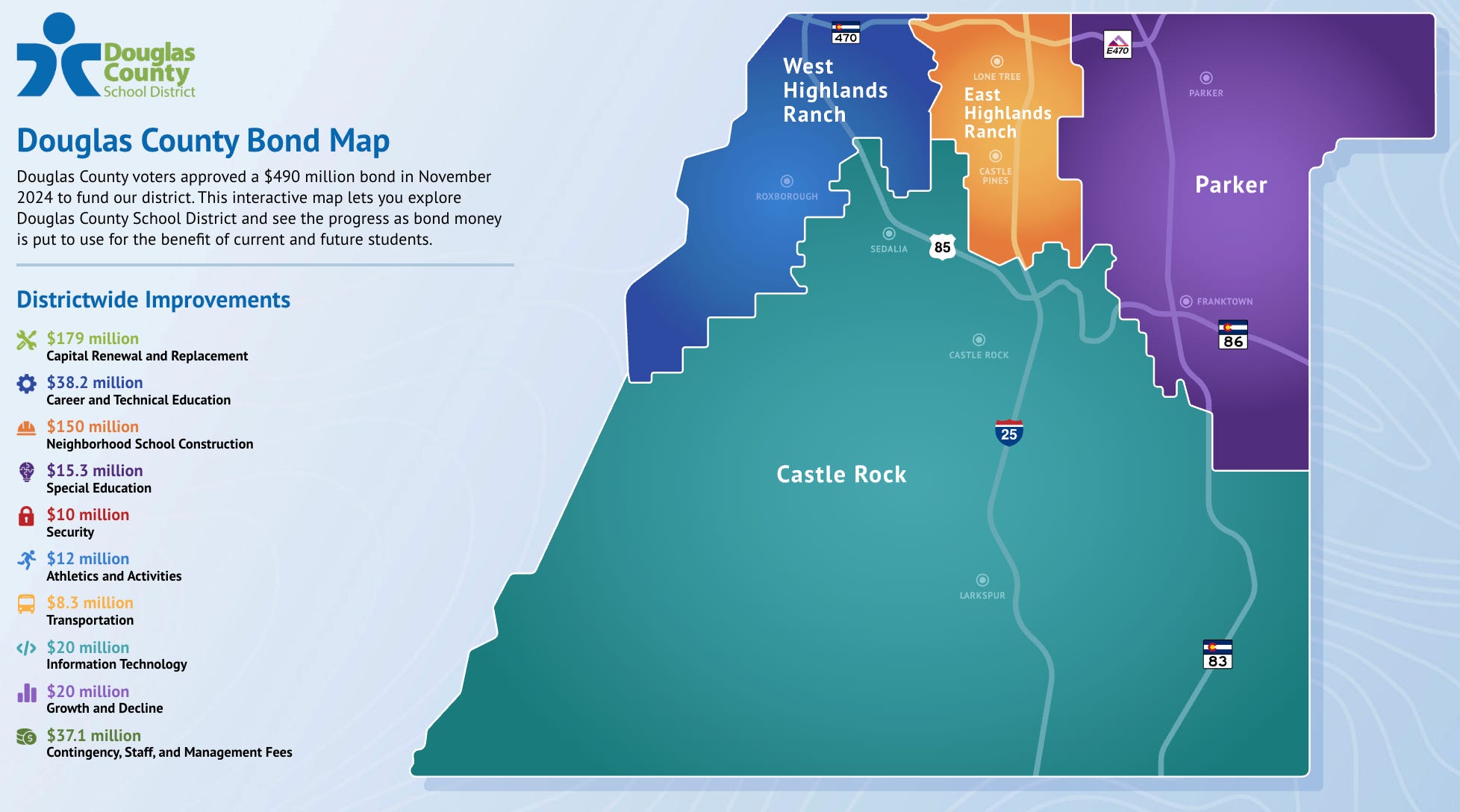
This interactive map let’s users dive into how the district has been putting that money to work and drill down to school-level projects.
Colorado is still behind
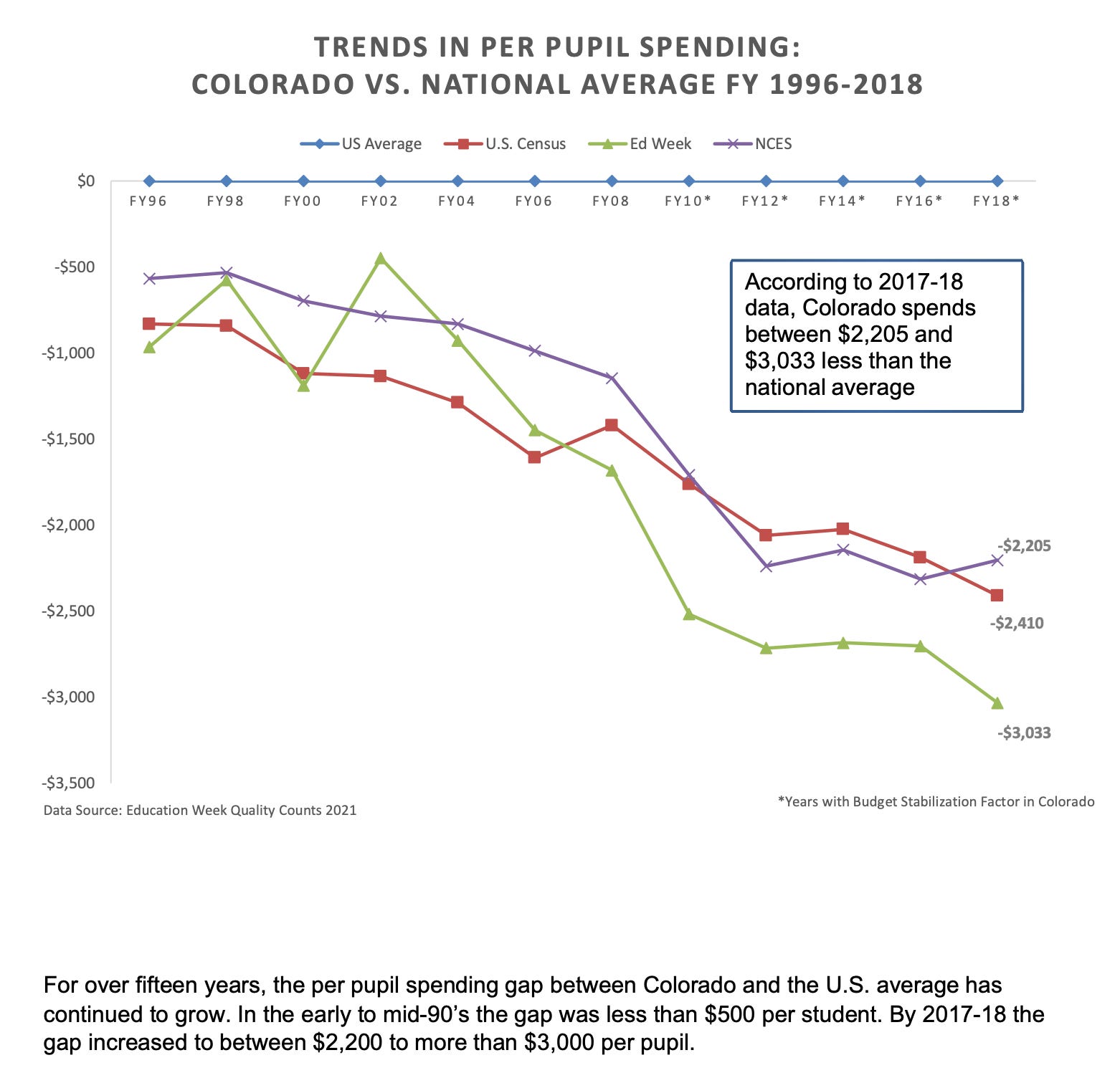
According to an Education Week Quality Counts 2021 article, per pupil spending in Colorado has steadily declined relative to the US average (the blue line in the graph below). In the mid-90’s, the gap was less than $500 per student. By 2017-18, the gap increased to between $2,200 to more than $3,000.
2025 legislation rewrites the school finance formula
In 2025, Colorado passed the Colorado School Finance Act (HB25-1320), which built on a prior school funding formula (HB24-1448). The new law starts with statewide, base per-pupil funding at $8,691.80 for 2025-26. Then the state layers in additional funding based on factors that reflect each district’s demographics and characteristics, an attempt to make funding more equitable across the state over a 7-year phased-in timeline.
HB25-1320 created a roughly $380 per-pupil funding increase — with rural schools and student-centered priorities at the front of the line.
The increase is notable because it comes despite declining statewide enrollment trends. The new formula phases in gradually through the 2030–31 school year, giving districts time to plan around the changes.
Douglas County Growth: building schools where the children are
Even as the district consolidates and closes schools in some areas, two fast-growing communities are creating urgent demand for new ones: Sterling Ranch (northwest Douglas County) and RidgeGate East (Lone Tree). Both are new developments with no existing school infrastructure — and both are attracting younger families, widening the gap between where kids live and where seats are available.
“Schools should be where the children are.”
-Superintendent Erin Kane
Douglas County Superintendent Erin Kane has described the apparent contradiction directly: as new communities grow, and as longtime residents in established neighborhoods age in place, the district must simultaneously open schools in some places and close or repurpose them in others. Both fast-growing communities plan to open new elementary schools in Fall 2026. In addition, the District is expanding Sierra Middle School in Parker, and the Legacy Campus in Lone Tree.
Concurrently, to address declining enrollment in Highlands Ranch, six elementary schools will consolidate into three for the 2026-2027 school year.
What comes next: a projected $15 million hole — and another funding ask on the horizon?
The District is projecting a $15 million shortfall in its operating budget for the 2027–28 school year, driven by a broader state budget shortfall estimated at more than $1.2 billion. The District operates under a balanced budget mandate dictated by both Colorado state law and local school board policy.
Against the backdrop of two growing communities without schools, a teacher pay gap that still sits 7% below market, and a capital backlog that took a decade to accumulate, district leadership is now considering going back to voters with an off-cycle funding request in 2026.
The 12-year gap between 2006 and 2018 is a cautionary tale: without consistent investment, needs don’t disappear… they compound.
The Question:
For more than a decade after 2006, the district made no additional funding requests. On the surface, the quiet looked like fiscal restraint. Beneath it, a backlog was building.
Capital improvement needs tend to accumulate gradually and largely out of public view — deferred maintenance on aging facilities, infrastructure that is past its useful life, and enrollment growth that the base funding formula was never designed to fully absorb. Each year without a bond measure or MLO was another year those needs grew more expensive to address.
By the time the district came back to voters in 2018, the bill had come due. The size and scope of that bond measure, and the extraordinary funding tools that followed, reflected not just the district’s current needs but the compounded cost of more than a decade of deferred action.
So the question facing Douglas County voters isn’t simply whether to spend more. It’s whether the cost of not acting is even higher in both the short term and the long term. Does the school really require another MLO to help with these costs.
Excerpts from DCSD Presentation on Potential 2026 MLO
Click here for full presentation.
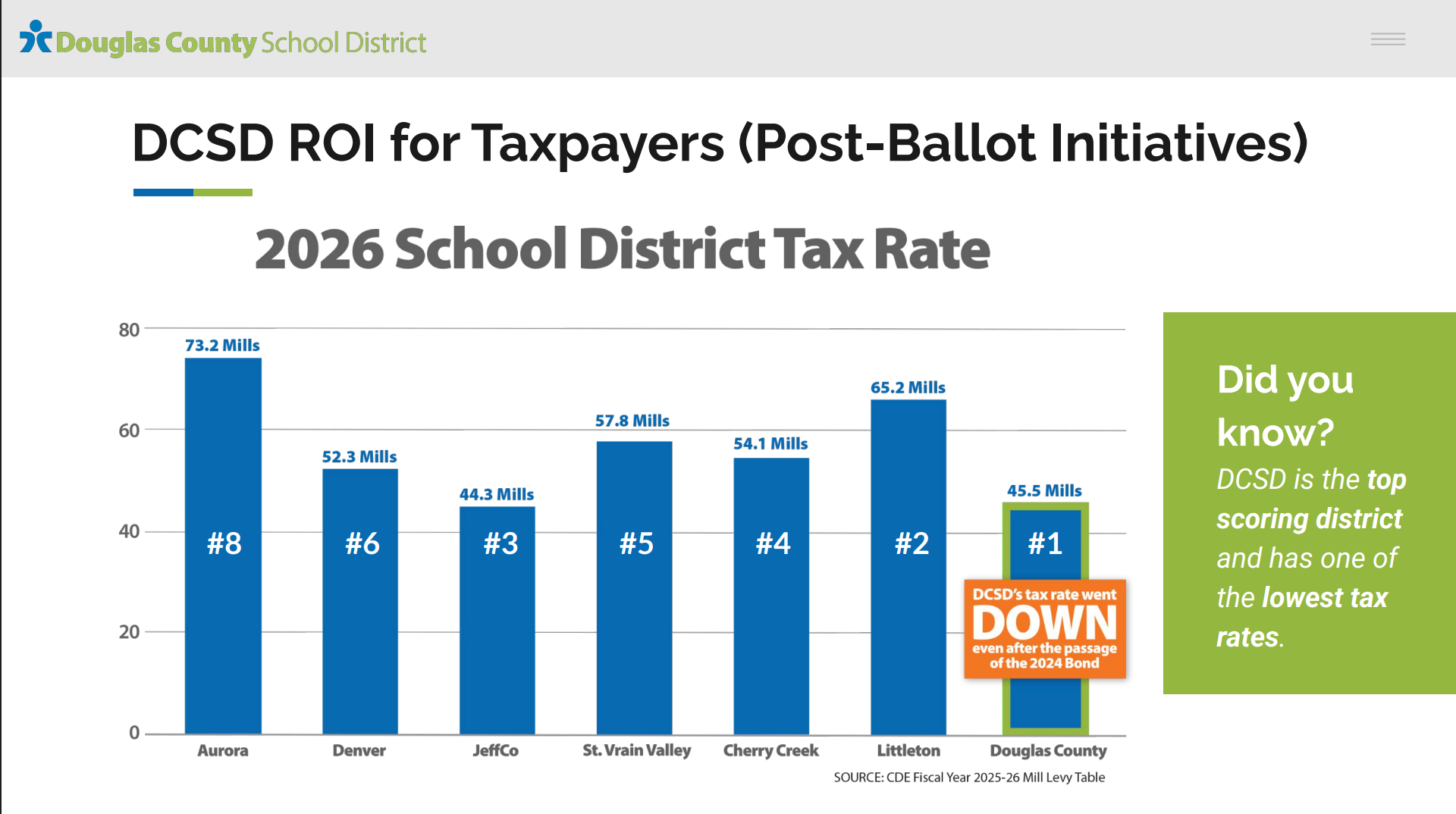
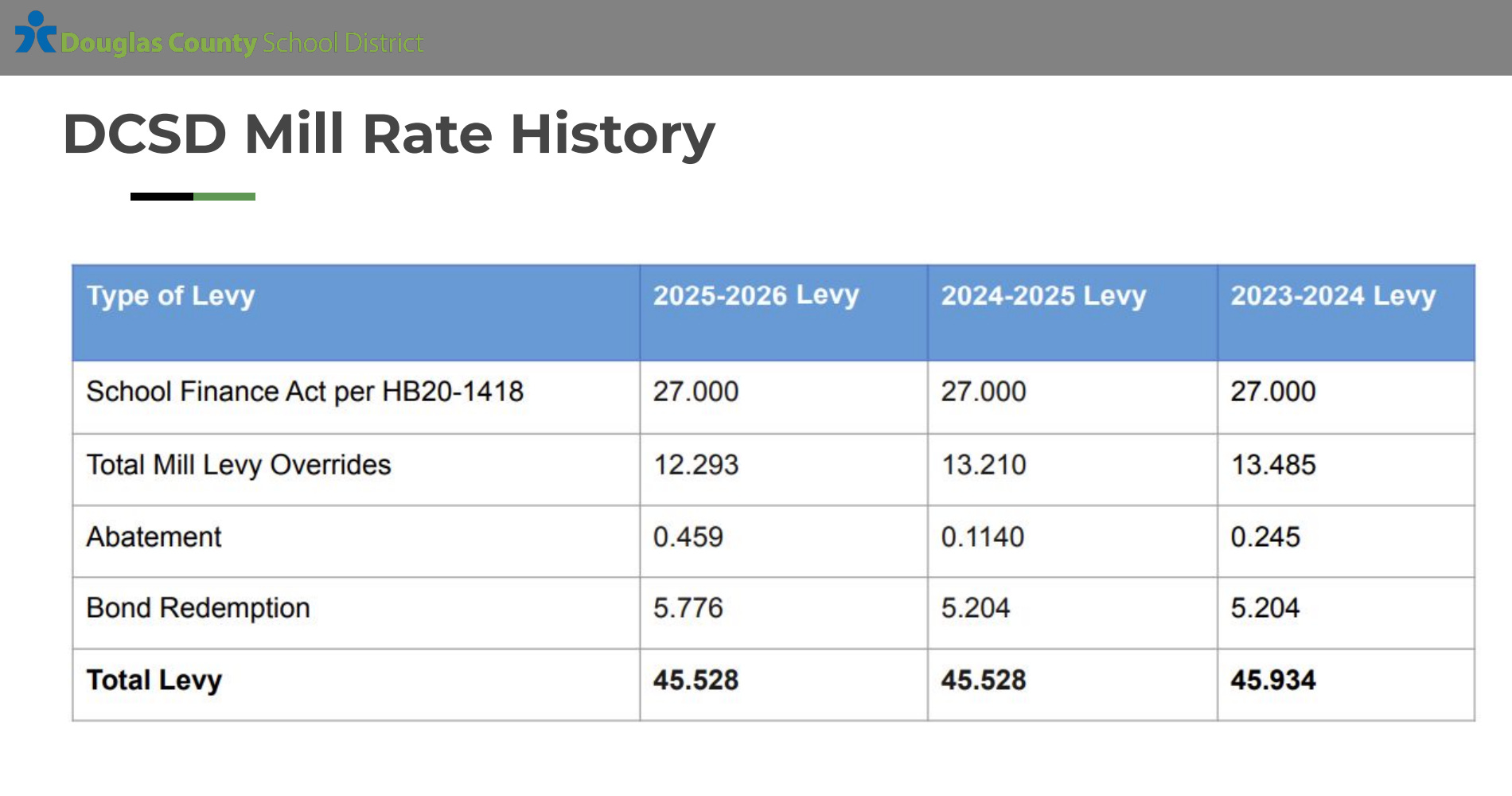

Very Informative.
Very informative !