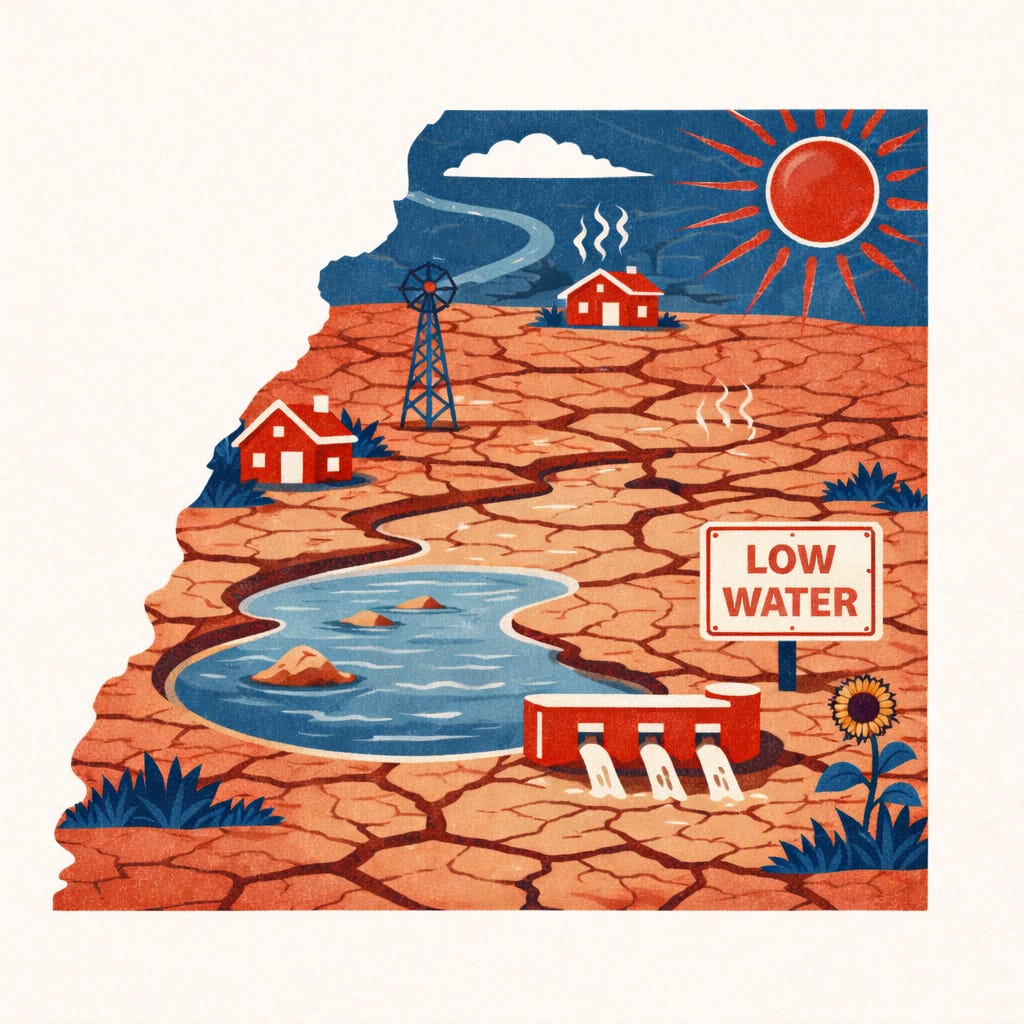
Following the Water: Drought Comes to Douglas County
The worst snowpack in Colorado history is testing water systems across the Front Range — and straining Douglas County’s planned growth
Colorado is having its worst snowpack year on record. That is not a local quirk or a bad season — water officials are calling it “exceedingly grim,” and the conditions that produced it are unlikely to be a one-time event. For Douglas County, this drought is more than a lawn-watering inconvenience. It is a stress test for a water system that already supports substantial growth in the arid American West, and it is raising urgent questions about whether the county’s development machine is built for a drier future.
Facts On The Ground In April
Colorado’s 2025–2026 snowpack peaked nearly a month early and came in as the lowest on record — worse than anything state water managers have tracked since at least 1941. The South Platte River Basin, which supplies the eastern half of the state and serves as the primary renewable water source for much of Douglas County’s long-term planning, is sitting at roughly 42% of normal. An unusually warm spring has accelerated snowmelt, meaning that thin snowpack is evaporating faster than it can be captured and stored.
State water officials convened an emergency session of the Colorado Water Conservation Board in January. By March, Denver Water — which serves 1.5 million people, including portions of Douglas County’s northern corridor — declared its first Stage 1 drought restrictions since 2013, asking customers to cut use by 20% and limiting outdoor watering to two assigned days per week. It was the utility’s fifth-ever drought declaration.
Aurora Water, which is the primary water supplier for the rapidly growing northwest Douglas County region through its arrangement with Dominion Water, formally declared Stage 1 drought restrictions in early April, targeting the same 20% reduction. Aurora’s reservoirs were sitting at approximately 68% capacity as of late March — representing only about 1.5 years of usable supply, with officials warning that Stage 2 restrictions requiring 35% reductions could follow if goals are not met.
The drought is already generating real costs for households. Denver Water imposed drought surcharges in April that will add anywhere from $7 to $76 to a summer bill depending on how much outdoor water a customer uses. Castle Rock Water is preparing its own tiered surcharges subject to town council approval, starting at roughly $6.91 per thousand gallons and rising to $10.31 if conditions worsen. One economic reality behind these fees: when utilities ask customers to use less water, they collect less revenue — Denver Water estimates a potential $30 to $70 million loss in revenue this year — and they pass some of those operating costs back to ratepayers through drought pricing. Customers are asked to conserve, and then asked to pay more for reduced use.
How Drought Restrictions Work, and Who Decides
Douglas County has no single water utility. Water is delivered by a patchwork of more than 20 entities — municipal departments, special districts, and metro districts — plus roughly 10,000 homes are on domestic wells. Each provider sets its own drought response policy, triggered by its own standards, approved by its own governing body. There is no countywide switch that someone flips.
The three largest providers — Highlands Ranch Water, Parker Water & Sanitation District, and Castle Rock Water — together serve about 70% of county residents. Each has a drought response plan structured in stages, with increasingly restrictive mandates at each level:
A Drought Watch is the earliest stage — voluntary conservation, public outreach, no mandatory restrictions. Highlands Ranch Water declared a watch on March 1, citing severe drought and predicting customer demand 22% above normal. Parker Water and Castle Rock issued conservation advisories around the same time, recommending customers delay sprinkler activation until mid-May and fix leaks before the season begins.
A Drought Stage is mandatory. Stage 1 typically means outdoor watering is limited to two or three assigned days per week with restrictions on what hours of the day water can be used on lawns. Stage 2 escalates cuts further, often requiring a 25–35% overall reduction, with commercial customers included. Castle Rock Water is preparing a Stage 1 request for council approval. Highlands Ranch is expected to watch conditions through spring before deciding.
The key variable is reservoir storage — specifically, how many months of usable supply a utility currently holds. Aurora Water’s threshold for Stage 1 is a 19- to 24-month supply. Denver Water’s is measured similarly. When a utility’s board or council votes to declare a drought stage, that action triggers mandatory rules. Violations can result in fines.
“We have about a year and a half worth of usable supply.”
Marshall Brown, Aurora Water General Manager - Sentinel Colorado
For homeowners on domestic wells, who are almost entirely unaffected by utility drought rules, the picture is different — and in some ways more precarious. Wells that draw from shallow aquifers can see yields drop significantly in drought years. Homeowners on wells are largely on their own.
How Douglas County Sources Water and Plans Ahead
To understand how drought hits Douglas County, it helps to understand that the county draws from two fundamentally different kinds of water, each with its own vulnerability.
Non-renewable groundwater from the Denver Basin aquifer system was the original backbone of Douglas County’s explosive growth. These deep bedrock aquifers sit beneath the Front Range from Greeley to Colorado Springs. They are non-renewable in the sense that the water that fills them fell as precipitation thousands of years ago and replenishes on geologic timescales, not human lifetimes. Pumping them is mining. Each well draws from a finite pool. As that pool shrinks, wells must go deeper, pumps work harder, and costs rise.
The good news is that deep Denver Basin groundwater is largely insulated from the current drought. You can’t fill it back up with a wet winter, but you also can’t drain it with a hot, dry summer. For utilities that still rely heavily on groundwater pumping — particularly smaller metro districts serving newer developments — this year’s drought is not an immediate crisis at the tap because they rely heavily on pumping groundwater, not siphoning off rivers.
Renewable surface water is the other half of the story, and it’s where drought lands hardest. Over the past two decades, Douglas County’s major providers have been working to shift their supply portfolios toward renewable sources: South Platte River water stored in reservoirs, recycled water for irrigation, and regional exchanges like WISE (Water Infrastructure and Supply Efficiency), which enables traded water deliveries among Aurora Water, Denver Water, and suburban partners.
Renewable water sources have tremendous upside for cost and sustainability, but are vulnerable to drought, climate change, and disasters. The South Platte River’s yield is near zero in dry years. The river’s flow, and therefore its yield, can swing from near nothing in drought years to 55,000 acre-feet in a wet year. Planning around flow variability requires substantial reservoir storage as a buffer.
The Platte Valley Water Partnership, a $780 million project anchored by Parker Water and recently joined by Castle Rock Water, is designed precisely for this problem: capturing high-flow South Platte water in wet years, storing it in northeastern Colorado reservoirs, and piping it south for use in Douglas County. That project is still years from completion.
The Aurora Water Connection: A Critical Vulnerability
One of the least-discussed but most significant water dependencies in Douglas County runs through the City of Aurora. Aurora Water is the primary supplier for Dominion Water & Sanitation District, the entity that provides water to Sterling Ranch — one of the fastest-growing master-planned communities in northwest Douglas County, and a development with new approvals to build thousands of additional homes.
Sterling Ranch is growing, it is served by Dominion Water, and Dominion Water depends on Aurora. Aurora Water just declared Stage 1 drought restrictions, with officials warning Stage 2 could follow.
This chain of dependencies is a structural vulnerability in Douglas County’s growth story. Aurora Water’s general manager told city lawmakers in March that the utility had “about a year and a half worth of usable supply” in its reservoirs — a thin margin that leaves limited room for error. Aurora’s supply portfolio draws from mountain watersheds that are all being battered by the same historic drought affecting every other Front Range water utility.
“If water is used in the same ways and at the same levels that it has been in the last 25 to 50 years, it elevates the risk that sufficient supplies may not be economically available to fully meet demands.”
Douglas County’s Draft 2050 Water Plan
Douglas County’s draft 2050 Water Plan does not squarely address what happens if Aurora Water, under pressure from its own growth and drought conditions, is unable or unwilling to expand deliveries to Dominion on the timeline that Sterling Ranch’s development projections require. It is an open question that the county has not yet answered when granting approvals for new development.
How Douglas County’s Water Supply Has Changed in the Last Decade
Ten years ago, a larger share of Douglas County’s water came from groundwater pumping. That has changed as utilities invest in renewable sources and reuse initiatives.
The major providers have made real progress. Castle Rock Water now operates one of the most diverse supply portfolios on the Front Range, combining local surface water, recycled supplies, regional imports, and strategic groundwater reserves. Highlands Ranch Water has built a system that treats groundwater largely as an emergency backup rather than a primary supply. Parker Water has invested heavily in renewable supply infrastructure, including its WISE partnership and its participation in the Platte Valley project. These are meaningful shifts, made over years of sustained investment and multi-jurisdictional cooperation.
The picture is murkier with smaller water providers — metro districts that often serve newly approved developments. Many of these districts still rely primarily on Denver Basin groundwater, and the county’s approval of new developments frequently depends on water commitments from districts that have not yet secured long-term renewable supply. The 2050 Water Plan acknowledges this dependency but does not establish a clear threshold at which groundwater reliance becomes too high to justify new development approvals.
The other major change in the last decade is efficiency. Per-home water use across the county has declined as newer homes are built to tighter standards and as utilities have invested in smart irrigation, rebates for turf conversion, and tiered pricing that penalizes heavy use.
All in, water is the currency for growth in Douglas County.
What Drought Means for Growth
If droughts like this one become the norm rather than the exception, at what point does water availability constrain growth? The draft 2050 Water Plan does not treat that as a question worth asking. Growth is assumed and treated as a constant — roughly 150,000 new residents and nearly 70,000 new households by 2050 — water is a variable, and water planning is framed as the exercise of finding a way to approve growth plans, not a question to answer before beginning construction. The plan’s own numbers show the buffer between supply and demand shrinking: demand up 30%, supply up only 12% through 2050. That math works today, but not if dry years reduce renewable surface water deliveries and increase the cost of groundwater alternatives at the same time.
“We always thought that 2002 was the worst possible year, but we are expecting something worse this year.”
Shonnie Cline, Aurora Water Spokesperson - The Colorado Sun
The 2026 snowpack illustrates what a supply squeeze looks like. When snowpack collapses and renewable water deliveries fall, utilities that depend on those deliveries have two options: pull more from groundwater reserves (which pushes up costs and accelerates depletion) or tell customers to use less. Both options cost money. Both options make water more expensive. And more expensive water is a cost that ultimately falls on ratepayers.
For housing development to continue at its current pace under increasingly dry conditions, Douglas County would need one or more of the following: much larger reservoir storage to buffer renewable supplies, faster completion of projects like the Platte Valley Pipeline, efficiency standards that are enforced, and for climate conditions to hold steady.
The 2050 Water Plan calls the approach it recommends “sustainable.” The Drought of 2026 is a preview of what it will look like when optimistic math gets tested in reality.
The Questions We Need Answered
How are Douglas County’s utilities coordinating their drought responses with Aurora Water and Denver Water, given how many county residents depend on those external providers?
What are the water conditions under which Douglas County would halt or slow new housing development approvals?
If Aurora Water restricts deliveries to Dominion Water during a Stage 2 or Stage 3 drought, what does Sterling Ranch do?
Part One of our water series: “Following the Water: How Douglas County Relies On Water It Does Not Control.”
Part Two: “Following the Water: The County’s Draft 2050 Water Plan.”
Sources & Recommended Reading
Colorado Water Conservation Board meeting, January 27, 2026 — Michelle Garrison, state water resources specialist: “Things are looking exceedingly grim.” YouTube recording
Colorado Sun, “Colorado water officials plan for ‘exceedingly grim’ drought forecasts, low reservoir levels,” Shannon Mullane, Jan. 28, 2026. Link
Colorado Sun, “Front Range water utilities impose restrictions and push conservation to combat drought this summer,” Shannon Mullane and Michael Booth, Mar. 25, 2026. Link — Highlands Ranch Water drought watch; Castle Rock Water Stage 1 consideration; Parker Water’s Ron Redd: “Using water wisely is something we can all practice every year.”
Colorado Sun, “Even if Coloradans slash their water use, their bills will likely rise during drought,” Jerd Smith, Apr. 3, 2026. Link — Denver Water $30–$70M revenue loss estimate; Castle Rock surcharge rates ($6.91–$10.31/thousand gallons); Aurora Water spokesperson Shonnie Cline: “We always thought that 2002 was the worst possible year, but we are expecting something worse this year.”
Colorado Sun, “Denver’s lawn-watering costs are going up for the drought. Here’s how much,” Michael Booth, Apr. 9, 2026. Link — Denver Water surcharge tiers; average customer cost $45–$52 extra; “hopes for a Miracle May snowstorm are dimming.”
Sentinel Colorado, “When In Drought: Aurora prepares for a year of severe water restrictions,” Mar. 25, 2026. Link — Aurora Water General Manager Marshall Brown: “We have about a year and a half worth of usable supply there.” Aurora reservoirs at ~68% capacity.
Denver7, “Douglas County residents question if county has the water to sustain growth,” Mar. 2026. Link — Highlands Ranch Water Sam Calkins on conservation value; Parker Water Ron Redd on demand increasing 5x in summer; Parker resident Kristin Ionga: “We’re not concerned for our lawn or anything like that, but we’re concerned more about the growth of our area.”
CPR News, “What to know about water restrictions across Colorado,” updated Apr. 16, 2026. Link — Statewide restriction tracker; South Platte Basin at 42% of normal; Colorado River Basin at 55% of normal.
KDVR FOX31, “Mandatory watering restrictions ordered for Denver amid drought.” Link — Denver Water spokesperson Todd Hartman: “We are in a really tough spot, we aren’t trying to alarm people but they need to realize this is a record low snowpack.” Denver’s 2026 declaration is its fifth-ever Stage 1.
City of Aurora, Stage 1 drought declaration, April 2026. Link
Denver Urban Gardens / Water Conservation FAQ, updated April 1, 2026. Link — Regional drought restriction summary; Douglas County status as of April 1.
Douglas County Draft 2050 Comprehensive Water Plan. Douglas County Water Plan page — Supply/demand projections (77,000 to 100,000 AFY demand; 143,000 to 160,000 AFY supply through 2050); quote: “if water is used in the same ways and at the same levels that it has been in the last 25 to 50 years, it elevates the risk that sufficient supplies may not be economically available to fully meet demands.”
Platte Valley Water Partnership project overview. Link
Water Infrastructure and Supply Efficiency (WISE), Denver Water. Link


Such thorough research reporting, as usual. I love to read the Lantern’s reporting!
The shine is coming off of Douglas County planning & Sterling Ranch when it comes to the natural resource of water.
Dominion water which is also the developer , relies heavily on other entities for water . They are not implementing any water restrictions in their community . I think they are too busy building as much as possible. The "entertainment district" along plum creek next to zebulon is in the works per sterling ranch CAB meetings. They are removing videos now to suppress and truth of their intentions ! 2/25/2026 removed . 3/5/2026 still up as of now.