Data Centers in Douglas County: Already Adding 10% To Our Energy Consumption
An Overview of Data Center Development
Data centers are increasingly at the center of public debate, as they power the artificial intelligence (AI) technology weaving itself into nearly every aspect of our lives—from business and shopping to web searches. These facilities require vast amounts of electricity and water, raising concerns about their environmental impact and effects on local utility bills.
If you’ve ever used ChatGPT, Claude, or clicked “AI Mode” in your browser, you’ve tapped into the computing power housed in a data center. As AI use grows, these centers demand even more resources — training a large AI model can require billions of calculations per second, sustained for years.
To keep up, data centers rely on specialized hardware and software. One key piece of hardware is the graphics processing unit (GPU), a chip originally built to render images and video quickly, which turns out to be great at the kind of rapid math AI needs. On the software side, AI models use an approach called “transformers,” which lets a computer look at many pieces of information at once instead of one at a time — a bit like reading an entire sentence in one glance instead of letter by letter. This is what allows AI models to respond so quickly.
But that speed comes at a cost: all this computing power requires a growing amount of electricity and water to run.
Residents often express concern or opposition to data centers, especially when one is proposed in their own community. According to a March 2026 Gallup poll, “Seven in 10 Americans oppose constructing data centers for artificial intelligence in their local area, including nearly half, 48%, who are strongly opposed. Barely a quarter favor these projects, with 7% strongly in favor.”
Many cities and towns have shied away from recruiting or approving new data center requests. For example, Denver recently enacted a one-year moratorium on new data center construction and permitting, halting the acceptance of zoning permits and site development plans while a task force drafts new regulations on energy use, water consumption, noise, and placement.
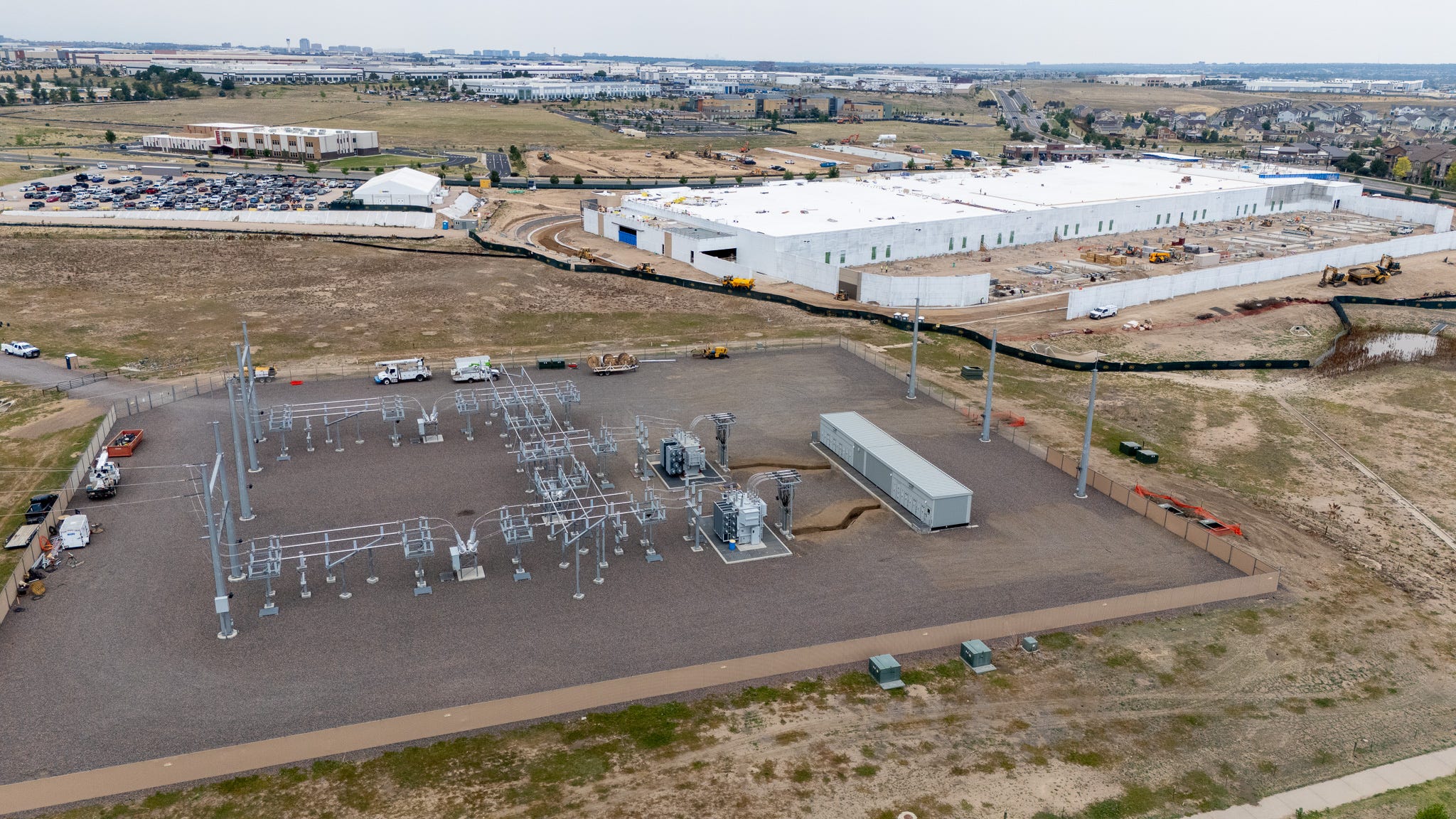
In contrast, Parker approved the Flexential data center project in 2021. The $192 million, 249,000-square-foot facility—located at 15255 Compark Blvd in north Parker—will be the largest in the Denver area and is expected to be operational by January 2027. Flexential followed the town’s standard development and public hearing process before beginning construction in late 2024. Core Electric Cooperative, an electric utility in Douglas County, will supply the facility’s power, and the Town of Parker collaborated on necessary zoning changes to accommodate the project.
Currently, Parker and Douglas County do not have restrictions or moratoriums on building data centers. All developers must still navigate local zoning codes, site development plans, building codes, and intensive reviews based on their planned development. According to 9News, the new Flexential facility will feature a 22.5-megawatt capacity and advanced, zero-water-consumption liquid-cooling systems.
This will be Flexential’s fifth data center in the Denver area. The new facility will be geared primarily towards businesses in the manufacturing, healthcare and financial services sectors based on the various contracts they will have with users of the data center.
The List of Concerns
While the list of concerns includes things like traffic, land use, and approval processes, the largest concerns about the emergence and building of data centers fall into 3 major buckets: power, water, and the environment.
Power
CORE Electric Cooperative will provide 22.5 megawatts (MW) of continuous power to the Parker data center, which is equivalent to the usage by roughly 15,750 Douglas County homes. CORE states this power is from available excess capacity. Census.gov says there are about 155,446 homes in Douglas County so 15,750 home equivalent is about 10% of DougCo’s current energy requirement - it’s a significant addition.
According to the Town of Parker, the data center will not increase electric rates for Parker residents or other CORE members. The Town of Parker also states that the data center will pay for its own infrastructure and energy.
But that’s not the case everywhere, and the differences from one jurisdiction to the next fuel concerns. As AI becomes more entrenched in our day-to-day lives, the demand for power could surge from the data centers processing AI. According to the Environmental and Energy Study Institute (EESI), data center power demands are contributing to higher energy bills because to cover the investments needed to accommodate the surge in data center requests, many utilities are passing on the costs to their consumers through higher monthly utility bills. According to EESI, Utilities requested more than $29 billion in rate increases in the first half of 2025, double the amount requested in the first half of 2024.
According to a study released in 2024 by the Electric Power Research Institute (EPRI), data centers could consume up to 9% of U.S. electricity generation by 2030—more than double the amount currently used. This could create regional supply challenges, among other issues.
CORE states they purchase wholesale power from Xcel Energy and the Western Area Power Administration. They also receive additional power from Comanche Unit 3, a supercritical, pulverized coal plant located in Pueblo and operated by Xcel Energy. And this is where some of the concern lies: using coal to generate electricity.
In response to state and local legislative requirements, CORE submitted a Clean Energy Plan to the Colorado Department of Public Health and Environment in late 2023. The plan outlined their path to an 80% reduction in greenhouse gas emissions by 2030, from a 2005 baseline, in line with House Bill 19-1261, which was Colorado’s effort to reduce greenhouse gas pollution.
Since filing the Clean Energy Plan, CORE reports that changes in the energy landscape and market have forced them to adjust their timelines and near-term expectations—in other words, they will not meet the commitments outlined in their plan. Although CORE initially secured contracts for new wind and solar projects, they now report that transmission system constraints and recent changes in federal renewable tax incentives have made these projects financially unworkable.
Ultimately, it remains to be seen what CORE’s emissions will do over time, and if they will ultimately pass on the costs of the infrastructure investments to their customers.
Water
AI data center servers produce massive heat, especially as companies increasingly integrate the advanced technologies of “transformers”, mentioned above, into their operations in addition to the large banks of computer hardware. Consider the heat a personal computer radiates after working for hours. Now multiply that by thousands of high-powered, densely packed servers conducting intense processing, 24/7/365.
Due to the high computation rate, servers must be constantly cooled, often using fresh water. If a data center also has on-site power plant facilities, water usage increases even further. EESI estimates that a 100-word AI prompt uses about one bottle of water, that large data centers can use up to 5 million gallons of water per day, or 1.8 billion gallons annually. To put that in context, Parker Water and Sanitation District currently provides an average of 7.8 million gallons of water a day to its users.
Recently, New York Representative Alexandria Ocasio-Cortez made headlines by displaying jars of the brown, polluted drinking water from Morgan County, Georgia during a House Committee on Energy and Commerce meeting. County residents point to a data center campus and its considerable construction projects as the culprit, though Meta claims their independent groundwater study found no impacts from the center’s operation and construction.
Food & Water Watch, an organization who states their mission is to fight for safe and healthy food, clean water, and livable climate, issued an article in March 2026, titled The Top 10 Reasons Data Centers Must Be Stopped. One of their main reasons is water usage: “Data centers also use massive amounts of water for cooling their servers, which run super-hot. We estimate that by 2028, U.S. data center water needs (just for cooling) could be as high as the indoor needs of 18.5 million U.S. households.”
Data Center Cooling Options

Industry estimates show that roughly 75–90% of data centers worldwide rely on water-based cooling as their primary method.Only about 10%–25% are completely water-free
According to Connect CRE and the Denver Business Journal, the Flexential Parker data center will be using a non-evaporative, closed-loop cooling system that requires no water for server cooling. This means that, in theory, the widespread concerns about water usage, a very limited resource in Douglas County, do not appear to be a concern. It is being reported that the site’s water hookups will only be for bathrooms and water fountains.
Environmental Impacts
While it is common for tech companies to deny environmental impacts by citing independent studies, the scale and speed of the current data center buildout is unprecedented.
The World Resources Institute reports that some data centers house gas power on-site for day-to-day operations, creating continuous air pollution and greenhouse gas emissions. Diesel-fueled backup generators also release harmful air pollutants, including fine particulate matter (PM2.5) and nitrogen oxides (NOx), linked to respiratory disease, heart disease, asthma and other serious health risks.
Noise is also an issue. Data center construction, rooftop cooling systems, and backup generators can be disruptively noisy. Smaller diesel generators reportedly reach 85 decibels, levels that can harm hearing. Larger industrial units can approach 100 decibels — equivalent to a motorcycle or jackhammer.
This noise can last for hours or days at a time.
To address this, some data center developers and local governments are beginning to use measures such as natural acoustic barriers, greater setbacks from homes, and improved insulation for backup generators.
Several sources report that the Parker data center will have backup generators, but they will only be used during a power outage, keeping noise levels low routinely.
According to Jackson Hoeke with Geddry, an independent reporting channel, many data centers provide their own power, but often through diesel generators that negatively impact air quality. One notable case is Amazon’s data centers polluting Canton, Mississippi. According to the Mississippi Free Press, the construction of a new data center led to not just noise pollution and heavy machinery keeping nearby families up at night, but significantly worse air quality due to dust and diesel fumes that caused respiratory illnesses in residents. In order to avoid the smallest disruptions in service, the Canton data centers must be powered by hundreds of these diesel generators. These generators release nitrogen oxides and benzene, among other pollutants. According to the Environmental Protection Agency (EPA) exposure to diesel exhaust can lead to serious health conditions like asthma and respiratory illnesses and can worsen existing heart and lung disease, especially in children and the elderly. These conditions can result in increased numbers of emergency room visits, hospital admissions, absences from work and school, and premature deaths. When the expansions to the Canton complex are complete, there will be over 300 diesel generators producing 240 tons of nitrogen oxide and 140 tons of carbon monoxide per year according to Amazon’s permit applications, and none of that electricity generated will go to the residents of the city.
Other Concerns
According to the Town of Parker:
The Flexential data center will not have a significant impact on traffic volume, nor will it emit pollution that will affect nearby residents and businesses.
Like all developments within Parker, the data center will be required to follow the Town’s noise ordinance (limited to a maximum of 60 dB between the hours of 7 a.m. and 7 p.m. and 55 dB from 7 p.m. to 7 a.m.). Any noise generated by this data center is expected to be limited.
Why People Want Data Centers
Among the 25% of people who support the construction of data centers, the reasons for that support vary. According to Gallup, two-thirds of those in favor of building data centers in their area cite the economic benefits, including 55% who mention increased job opportunities specifically. Others mention increased tax revenue (13%), housing and infrastructure development, and general economic benefits.
Smaller shares of data center proponents mention the potential benefits of AI to technology or themselves, personally.
According to the World Resources Institute, data center development can create real economic opportunities. Construction generates hundreds of well-paying — though temporary — jobs for technicians, electricians and other local building trade workers. There are also good-paying opportunities for full-time staff, like technicians, security staff and facility managers. But those permanent jobs typically are fairly limited. A review of more than 1,200 U.S. data centers found that even the largest employ fewer than 150 permanent workers, and sometimes as few as 25.
Colorado State Policy Backdrop
The state legislature has been active on this front. There were two competing data center bills in the 2026 Colorado legislature, and both failed — Colorado ended the session with no new statewide data center regulations at all.
HB26-1030 — Data Center & Utility Modernization (sponsored by Rep. Alex Valdez and Rep. A. Valdez)
Industry/labor-backed bill, formally titled the “Colorado Data Center Workforce, Clean Energy, Grid Modernization, and Consumer and Environmental Protection Act.”
Would have offered a 100% state sales and use tax exemption for up to 20 years for certified data centers on computer equipment, software, and energy systems, with a possible extension of 10 years based on satisfaction of post-certification requirements, and required operators to invest a minimum of $250 million in data center infrastructure within five years, create new full-time jobs, and meet detailed labor and wage standards. Spencer Fane
Outcome: Postponed indefinitely. Valdez presented an amended version to strengthen environmental guardrails, then proposed it be postponed indefinitely, and the House Energy and Environment committee voted it down 11-2. Colorado Public Radio
SB26-102 — Large-Load Data Centers / Accountability measure (sponsored by Sen. Cathy Kipp and Rep. Kyle Brown)
Consumer/environmental-backed bill. Rather than tax breaks, it would have required developers to use and develop renewable energy, pay for the full cost of their electricity and any grid investments they require and practice smart water consumption. NRDC
It defined “large-load data centers” as a new data center with a peak load over 30 megawatts, or multiple new centers with a combined peak load over 60 megawatts, or existing centers that add that much load, and would have directed the Public Utilities Commission to determine by June 30, 2030 whether 100% hourly matching (of energy use to renewable generation) was technically and economically feasible for these data centers. Colorado General AssemblyColorado General Assembly
Outcome: Also died. The bill was assigned to the Senate Transportation and Energy Committee, where the nine-member committee voted unanimously to postpone it indefinitely. Spencer Fane
Why both failed: Lawmakers spent nearly a year trying to negotiate a compromise pairing incentives with guardrails, but competing bills — one backed by business groups, and the other by consumer and environmental advocates — both failed to advance from committee in the final days of the session, and negotiations over a compromise measure didn’t produce an agreement lawmakers would accept. These were also among the most fought-over bills of the year — HB-1030 and SB-102 had 196 individual lobbyists registered on one or both bills, on behalf of 150 clients. Colorado Newsline
What’s filling the gap: With no state-level rules passed, local governments including Weld County, Larimer County, the City and County of Denver, and Logan County have moved forward on their own zoning ordinances, special-use permits, and moratoriums — Logan County’s rules, for example, apply to any data center facility with a nameplate capacity of 1 megawatt or more. Spencer Fane
Implications
For AI usage to expand in the U.S., data centers that can handle the necessary computing power will have to be built. The centers that have already been built are usually funded by the large technology companies seeking to offer AI services. But most Americans appear to be adopting a “not in my backyard” attitude to building additional data centers, and that attitude is especially intense, given that nearly half “strongly oppose” that construction.
Overcoming this opposition stands as a major hurdle in the expansion of AI computing. The intensity of opposition means that proposed data centers are likely to spur grassroots activism from local residents as well as legal challenges. It also indicates that AI infrastructure could become an important campaign issue in local and state elections this year, and politicians who favor data centers in their area are likely taking a politically risky stance. [Source: Gallup]
Who is Flexential?
Flexential was created in 2018 with the acquisition of Denver-based ViaWest, a national data center developer, by Charlotte-based Peak 10. The $1.7 billion purchase of ViaWest created a national company with 40 data centers in 21 metropolitan areas.


