


All documents provided by Douglas County for the relevant CORA Requests are being made accessible at this link. Many files are email communications from Microsoft Outlook, you can view them with any .msg file viewer but we use Encryptomatic.
The original version of this article conflated Sterling Ranch Development Company with the Sterling Ranch Community Authority Board (CAB) and has been edited for clarity.
On March 31, 2026, the Douglas County Board of Commissioners convened a special business meeting and approved a contract agreement retaining Stifel, Nicolaus & Company as the county’s financial advisor for the proposed Zebulon Regional Sports Complex. The contract was for planning the issuance of Certificates of Participation (public debt) that county materials describe as $100 million over 30 years. The contract fee: $137,500.
The vote to approve the contract took just a few minutes in March, but the paper trail of Stifel’s work for the county dates back almost a year before commissioners formally hired them. Because the contract was for a financial advisor with a fiduciary duty to its client, it means that during the time before the March 31 contract, at least 9 months, Stifel may have been conducting financial advisory work without a fiduciary duty to Douglas County.
Stifel also advises the Sterling Ranch Community Authority Board (CAB), and the debt it was working on for Douglas County will eventually fund both Zebulon and a contract awarded to SR Construction LLC., an entity associated with Sterling Ranch Development Company.
Emails and documents produced in response to a CORA request show that Stifel transmitted a signable financial advisory agreement to County Manager Doug DeBord and Budget Director Martha Marshall on June 12, 2025. Six days later, Marshall reported to DeBord that the fee had been agreed to. Through the fall and winter that followed, before any public agenda item that approved the contract, Stifel was advising county staff, building a financing strategy, and modeling repayment structures for Zebulon debt. But the contract was not approved until March 31, 2026 in a special business meeting covering a range of Zebulon issues.
The records reviewed by The Lantern contain no request for proposals, no competitive bidding, and no documented justification for the selection of Stifel. A separate records request seeking exactly those documents was fulfilled by the county on April 20, 2026; the records produced in response to that request contain no correspondence detailing any competitive, public contract bid commonly known as a Request for Proposal (RFP).
Distilling the Problem
This story is driven by a timeline that has been in motion for over a year and was pieced together from a broad records request. It is also filled with technical, legal, and ethical questions. Before diving into the narrative, we want to provide a high-level overview of the issues.
Conflict of Interest: Should Douglas County be engaging a consultant to structure county debt when that consultant also works for the Sterling Ranch CAB, the entity that received a $12 million construction contract from taxpayers to build the project being financed by that same county debt? Many lawyers, financial advisors, and consultants have client entanglements that are resolved by disclosures and legal requirements. Without disclosures in any scenario, let alone on the public payroll, a situation like this one could look on its face as if the web of people involved are coordinating using taxpayer dollars to march toward lucrative profits.
No Bid Contracts: Government contracts are often awarded in a competitive bidding process, and Douglas County certainly knows how to award contracts by putting out Requests for Proposals that are publicly accessible. The theory is that governments should seek competitive bids to be good stewards of taxpayer dollars and to discourage cronyism when awarding government money. When the County issues a sole source contract, its own Purchasing Policy is to provide written justification. All sole source purchases must be approved by the County Manager. The County Commissioners appear to have engaged Stifel as a financial consultant without seeking other offers. Stifel has an existing relationship with the Sterling Ranch CAB, sat down with county officials and Sterling Ranch principals to discuss strategy, and the work Stifel did for the county will fund a contract awarded to a Sterling Ranch entity. If you are Stifel in that room, how you ostensibly serve both clients (at least one of whom if not both are heavily reliant on taxpayers) is at a minimum a complicated scenario.
Working Without Approval: Stifel appears to have conducted significant work for Douglas County for the better part of a year without a contract in place that would have clarified or safeguarded the county’s interests. Keeping the process, decisions, and information related to county government out of the public eye for months is an issue the County Commissioners are already grappling with at the Colorado Supreme Court.
Advising With Potential Motive: Until Stifel had an executed contract, it is not clear they had any fiduciary responsibility to give the county advice in the best interest of taxpayers. Nonetheless, Stifel was giving the county advice. Stifel’s own disclosures call into question how and when they intended to benefit from the deal they structured. Federal regulations prohibit scenarios that are entirely possible given the timeline of events. It’s a startling level of legal exposure for Stifel and Douglas County that could have been easily avoided by executing a contract in a timely manner with required disclosures or by selecting almost any other financial advisor.
No Competitive Bids, Rushed Into Service
The most direct evidence that the selection bypassed the county’s normal process comes from inside the county’s own Finance Department.

On March 27, 2026, the same day the Stifel agreement was submitted into the county’s agenda publishing system (Legistar) for a March 31 meeting, Director of Finance Christie Guthrie emailed Martha Marshall and Kim Hirsch, a county budget officer: “Did you post an RFP for Financial Advisory Services? I am seeing a contract in Legistar for Stifel.” Guthrie added that she understood Piper Sandler, another public finance firm, “had a conflicting interest and so we couldn’t use them,” and asked whether that had changed. “I just want to be sure we have gone back out to bid if needed,” she wrote.
No reply to Guthrie’s question appears in the records the county produced. Four days later, at its March 31, 2026 business meeting, the Commissioners approved the agreement with Stifel.
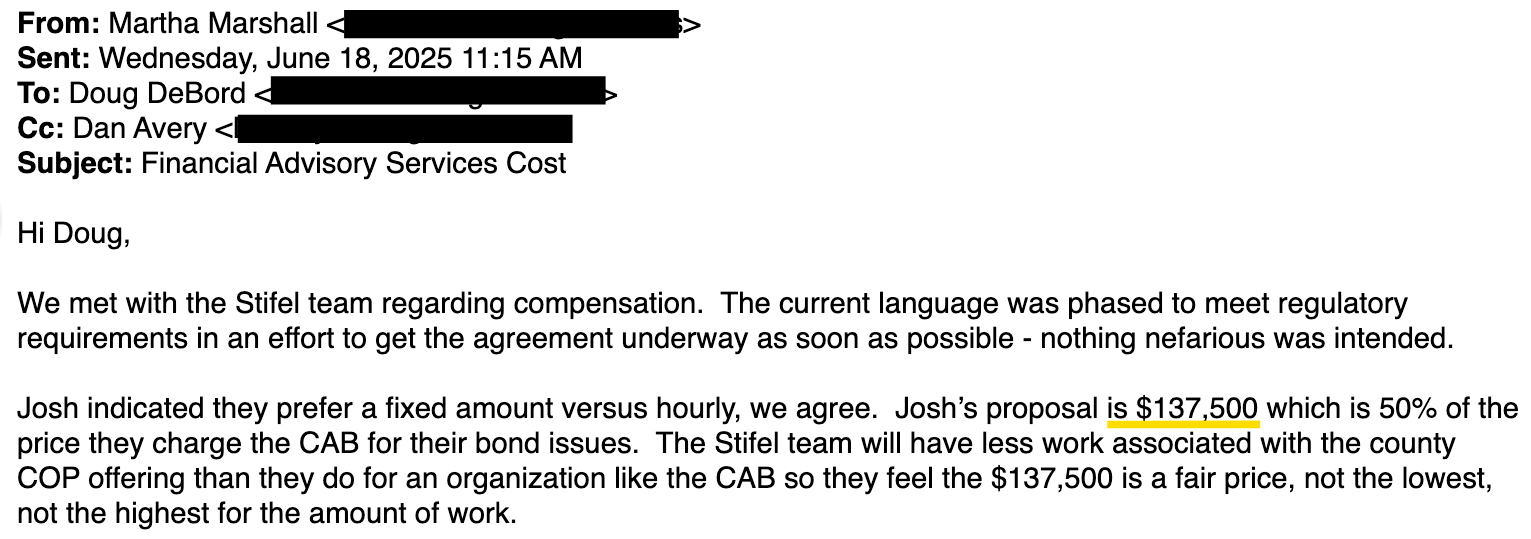
The contract fee was negotiated almost a year before the contract was approved. In a June 18, 2025 email to DeBord, Marshall described a meeting with the Stifel team about compensation: Stifel’s proposal was “$137,500 which is 50% of the price they charge the CAB for their bond issues.” The Sterling Ranch Community Authority Board (often abbreviated as “CAB”), is the government entity that issues bonds for Sterling Ranch development. Marshall added that the agreement’s “current language was phased to meet regulatory requirements in an effort to get the agreement underway as soon as possible.” Nevertheless, more than nine months lapsed before the agreement was approved by the Commissioners.
A Servant of Two Masters
The fee discussion matters for a second reason. It establishes that the firm the county hired as its fiduciary advisor had a pre-existing and ongoing client relationship on the other side of the Zebulon project: Sterling Ranch.
The Zebulon sports complex sits on land the county acquired in a swap with Sterling Ranch. The site’s grading and infrastructure work went to SR Construction LLC (i.e. Sterling Ranch Construction) in a roughly $12 million agreement approved the same night as the Stifel contract. And calendar records from December 2025 show Stifel’s team — managing director Josh Benninghoff, director Stacey Mast, and associate Hadley Seymour — were included on a “County/Sterling Ranch call” with Sterling Ranch principals Brock Smethills and Tim DePeder, Brownstein Hyatt attorney Carolynne White (it is not clear who Brownstein Hyatt represents on the call), and county leadership. In other words: county commissioners and Sterling Ranch owners sat down with a consultant that advises multiple stakeholders in the issuance of taxpayer-funded debt for a discussion that would eventually benefit Sterling Ranch for the construction of Zebulon.
The Minutiae of Two Very Important Rules
The Dodd-Frank Act was signed into law in 2010. This legislation was designed to usher in new financial and consumer protection rules and included regulations for municipal governments. Two of those rules are related to this narrative: Rule G-23 and G-42.
The Dodd-Frank Act describes roles a firm cannot occupy at the same time. Rule G-23 prohibits the same firm from serving as both municipal advisor and underwriter on the same debt issuance. Under Rule G-42, a municipal advisor owes its government client a fiduciary duty, a legal obligation to put the government’s interests first, disclose material conflicts in writing, and recommend only what is suitable for the government client. An underwriter (the firm that sells government bonds to the market) buys the securities from Douglas County to resell them. Federal rules require firms handling one side of the transaction to make significant disclosures about their role and potential conflicts of interest.
Stifel attached disclaimers to its emails, the language stating the firm “is not acting as an advisor,” “does not owe a fiduciary duty,” and “seeks to serve as an underwriter on a future transaction.” Stifel repeatedly signaled in documents that it was wearing the hat of a firm that may benefit from selling Douglas County’s debt later while advising on how to structure that debt. Rules G-23 and G-42 seek to prohibit that.
For roughly four months, from December 2025 to February 2026, Stifel supplied the county the kind of advice a financial advisor provides, without an executed contract and while the disclaimers on its correspondence declared that no advisory duty applied and that the firm might be angling for the underwriting role to eventually sell the County’s debt. A fiduciary responsibility (under Rule G-42) did not necessarily materialize until the contract took effect on March 31, 2026…months after Stifel had already been advising the county on a major financial transaction Stifel could theoretically have benefitted from later.
Conflict disclosures attached to the executed Stifel agreement run several pages, but they are generic. They disclose that Stifel is a full-service financial institution and they do not disclose Stifel’s work for the Sterling Ranch CAB, even though the county’s own correspondence shows staff knew of that relationship when their fee was set. Whether Federal law required a more specific disclosure here is a legal question The Lantern cannot resolve; whether the county evaluated the relationship as a conflict before hiring Stifel is unknown but was not included in their response to the relevant CORA request.

The disclosures do identify one other item: a September 2024 SEC cease-and-desist order against Stifel, in which the firm admitted its personnel used off-channel communications in violation of federal recordkeeping rules and paid a $35 million fine.
Advice Given Without a Fiduciary Duty
From December 2025 through March 2026, before the Commissioners approved the agreement, Stifel was functioning, in practice, as the county’s advisor. In February 2026, Stifel produced a financing calendar and delivered repayment scenarios for a debt issuance at 20-, 25-, and 30-year terms. In March 2026, Marshall told DeBord she was postponing an internal meeting because, “I’ve been in contact with Stifel as questions arise,” indicating communications with Stifel were routinely happening before contract approval.

Yet every one of those Stifel emails carried the firm’s disclaimer under Rule G-23 that Stifel “is not acting as an advisor to you and does not owe a fiduciary duty,” is “acting for its own interests,” and “is serving as an underwriter, or seeks to serve as an underwriter on a future transaction.”
For months the county was taking debt-structuring advice from a firm that was formally disavowing any obligation to put the county’s interests first.
What The Public Is Told vs. What Documents Show
The Lantern’s examination of records provided by the county reveals that internal records diverge from public information about the financing of Zebulon in at least three ways: size of debt obligation, repayment plan, and authorship of county communications.
Size of Debt Obligation
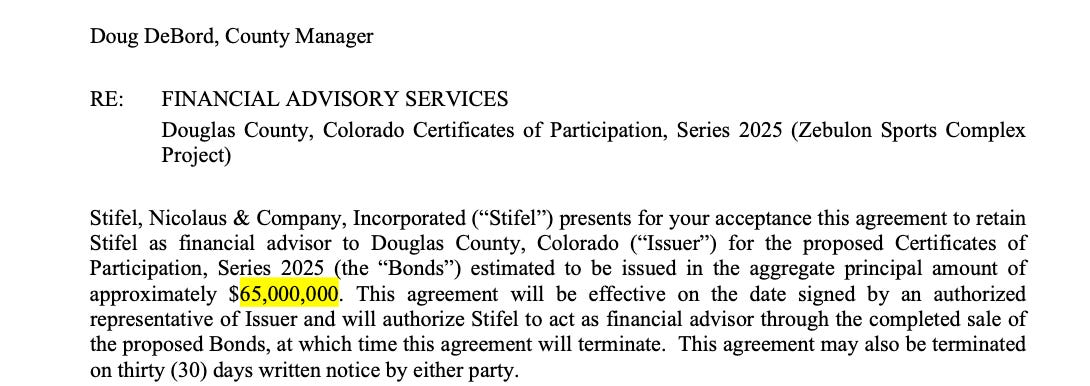
The executed agreement covers Certificates of Participation “estimated to be issued in the principal amount of $65,000,000.” An agenda summary, Stifel’s own models, and talking points from a March 31 presentation describe a $100 million debt obligation. Talking points drafted by Marshall on March 22 state the County Revitalization Authority’s (CRA) funding mechanisms would not be used for Phase 1 construction of Zebulon, but the county’s advisory contract expressly contemplates CRA bonds for this step in building Zebulon.
How to close the funding gap, what amount is actually needed, and what entities will be funding Zebulon are open questions.
Repayment Plan
Certificates of Participation are “not considered debt under TABOR” and therefore require no voter approval. In internal correspondence, Marshall advised DeBord that she was concerned initial payments “will need to come solely from sales tax until the facility starts generating revenue.” This suggests county staff are at least contemplating that general fund revenues will need to prop up Zebulon construction for a period of time.
The county also seems to have selected a 30-year escalating-payment structure on the expectation that “we’ll likely restructure the debt in 10-15 years...so we won’t be faced with the higher payments in the later years.” This would probably be interesting information for the investors buying Douglas County’s debt: that the County does not ultimately envision paying escalating debt payments.
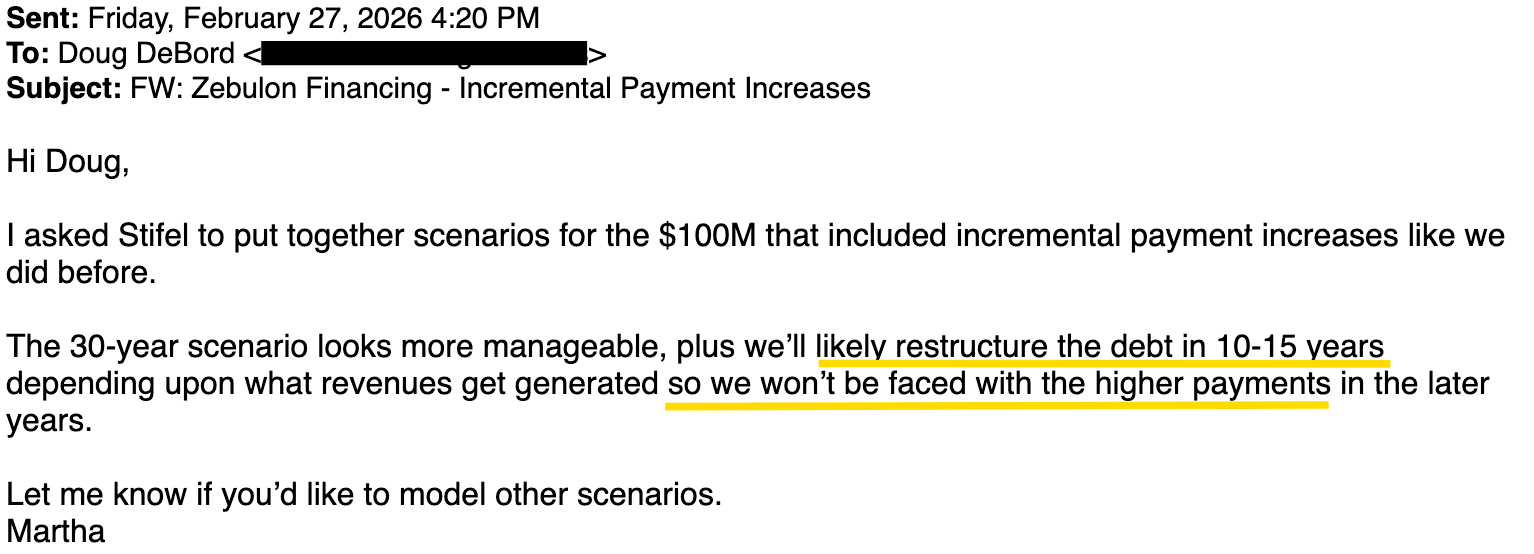
The current County Commissioners are, therefore, moving taxpayers into a debt structure that they reasonably expect to be unaffordable in decades to come without refinancing. The county has also discussed relying on revenues from sales tax for a significant period of time to make the Zebulon math work.
The Quiet Part Out Loud
On April 6, Marshall asked Stifel to draft the answer to a citizen’s question — “What is the difference between a bond and COPs?” — for posting on the county’s website. The response emphasized that COPs “do not require voter approval,” and was forwarded verbatim to county communications staff. The county’s public-facing material on Zebulon financing is being written by a third party consulting firm, and it seems to admit that COPs are being used because of a hesitation to take Zebulon debt approval to voters.
The Hour After a CORA Request
One final timestamp is worth noting. The CORA request that produced these records, which specifically sought an explanation for selecting Stifel, was transmitted to the County Commissioners at 2:49 p.m. on April 30, 2026. At 3:35pm, about 45 minutes after the CORA request was filed, DeBord forwarded two documents to Marshall and Deputy County Manager Dan Avery: the June 2025 fee email and the June 2025 Stifel agreement transmittal. The timing of those forwarded documents confirms that the county knew precisely where the origin of the Stifel agreement was: not in March 2026, when the public first saw it, but the previous June. This suggests that county leadership knew they were operating without a signed contract with Stifel for months. They did not have to search deep for the records requested and, indeed, seem to have sprinted into action over the CORA request.
Questions We Need Answered
Will general fund sales tax be used to support Zebulon construction until it generates revenue?
Under what provision of the county’s Purchasing Policy was a $137,500 professional services contract awarded without competitive bids?
Why did the County Commissioners delay approving a contract with Stifel for almost a year?
What answer, if any, did Finance Director Christie Guthrie receive to her March 27, 2026 question about an RFP, and who decided the item would proceed to the March 31 agenda without a competitive bid?
Did the county assess Stifel’s work for Sterling Ranch-affiliated entities as a conflict before retaining the firm as its fiduciary?
Why does the executed agreement cover $65 million in debt plus County Revitalization Act (CRA) bonds when the county’s public materials detail a $100 million funding requirement and no CRA involvement?
What was the nature of the conflict of interest that prevented Piper Sandler from participating in the RFP process?
When did the Board of County Commissioners first discuss the Stifel engagement — in work sessions or executive sessions — before the sole public vote on March 31, 2026?
Will any Federal funding benefit the Zebulon project and trigger audit requirements from a U.S. Inspector General that would press the G-23 and G-42 rules issues?
A.I. Disclosure
The Lantern used Claude Fable 5 to review the massive documents package produced by Douglas County for our CORA request. Without it our volunteer team simply could not get through the processing, so this tool enabled us to do something we otherwise could not do. As with all Lantern writing, our drafts are peer-reviewed before publication. We are providing the entire document package to the public.