


Concerned citizens in Castle Pines are circulating the first ever citizen-led petition in their city to amend the 2019 home rule charter. The grassroots effort has come on the heels of the controversial Crowsnest annexation request that was ultimately withdrawn by the developer, Ventana Capital. That withdrawal coincided with a 120-day moratorium on annexations from the City and Council directing staff to draft a formal annexation policy for their review by July 17.
Concerns about Crowsnest led Castle Pines residents to pack their City Council meetings in February and March. Many of those same residents are now collecting signatures for a ballot initiative that would require voters to approve any future annexation. If the petition gathers enough signatures, Castle Pines voters will decide whether to approve two charter amendments when they vote in November.
What Are the Amendments?
Amendment 1: Voter Approval for Large Annexations
Amendment 1 would require the approval of registered Castle Pines voters for any future land annexation of 20 acres or more—including multiple parcels placed together.
Amendment 2: Ratification of Recent Annexations
Amendment 2 would require that any parcel over 20 acres annexed within 180 days prior to Amendment 1 going into effect would be referred back to the voters for final ratification. In effect, this amendment would close a temporary, six-month loophole and discourage developers from seeking annexations before Amendment 1 takes effect.
Why These Amendments and Why Now?
City staff has until mid-July to present the City Council with a draft annexation policy. Organizer Donna Packard, a Castle Pines resident, explained, “The timing of these petitions has been managed carefully and in coordination with the City Clerk’s office to ensure that the proposed Amendments to the city’s Charter would not trigger a special election and all the costs that would come along with that. The City Clerk’s office has been extremely helpful to us throughout this process.”
Amendment 2 was designed to ensure accountability to voters for any annexation decisions the City Council might make between the adoption of the annexation policy (as early as July or August) and the November election. Packard noted that, if there have been no annexations in the 180 days prior to voter approval, City Council could deem Amendment 2 moot.
“Castle Pines leadership is busy developing a solid, well thought out annexation policy which will guide our leaders and developers to craft annexations that are consistent with our Comprehensive Plan,” Packard said. “At the same time, we are busy making sure citizens have the ability to approve annexations that add value to our community and disapprove those that do not.”
The Amendments’ supporters argue there’s no guarantee that a formal annexation policy will address their concerns and provide the government accountability they are seeking in annexation decisions for Castle Pines. They believe the amendments will create an important check on the power of the City Council and motivate council members to be directly accountable to voters for balancing the City’s growth with its ability to provide community services (e.g., water, fire, police, schools) and maintain the City’s character.
Organizer Lorrie Ball added, “We want people to understand that these petitions are not just a response to the withdrawn Crowsnest request. That annexation proposal raised important questions. Why are there no policies and fee structures for annexations? How will annexations support our Comprehensive Plan and the strategic Economic Development Plan that is currently being developed? These Amendments are about giving citizens a voice to hold our leaders accountable for adhering to standards that can be applied to all future annexation questions.”
Packard summed it up, “This is a way for voters to weigh-in on their concerns related to thoughtful development, guided by strategic economic development plans and a comprehensive plan for the community.”
How do other communities approve annexation?
Most communities in Colorado approve annexations through local elected officials like City Councils. But there’s very recent precedent for voter approval of annexation. In September 2025, nearly 70% of the voters in the town of Palmer Lake approved a new ordinance to require voter approval for future annexations. That vote came after the town’s elected officials approved eligibility for the flagpole annexation of a Buc-ee’s and also resulted in the recall of two of those officials.
People who oppose the Amendments are skeptical that development will ever happen if it requires a vote of approval from current residents. They argue that City Councils are elected to make those kinds of decisions.
Some Colorado Springs City Council members agree. Although the mechanics of voter approval were different, the Karman Line annexation in Colorado Springs also resulted in a petition for a special election in which voters overwhelmingly reversed the City Council’s annexation approval. One Colorado Springs City Council member defended annexation approval by elected officials instead of by voters saying, “There are a lot of very important milestones and boxes that need to be checked along the way. Everything from utility infrastructure, the cost of utilities, who pays for the utility expense or infrastructure cost.”
Is Castle Pines Checking All the Boxes?
Crowsnest was the first major annexation decision since the City’s charter was adopted in 2019, and the City Council missed checking two critical boxes for making an annexation decision.
Annexation Policy
Despite having no formal policy guiding annexation decisions, the Council unanimously declared Crowsnest “eligible for annexation to the City of Castle Pines” on February 24. At their annual retreat on March 7, the Council discussed annexation. Then, at their next public meeting on March 24, they directed staff to draft an Annexation Policy after finding “that a Council-adopted annexation policy, in addition to the statutorily-required Three-Mile Plan, is necessary to provide direction to potential applicants and staff on when and how the City may want to expand its boundaries.” Just one month after declaring Crowsnest eligible for annexation, the Council decided it needed more clarification on the criteria for eligibility.
Three-Mile Plan
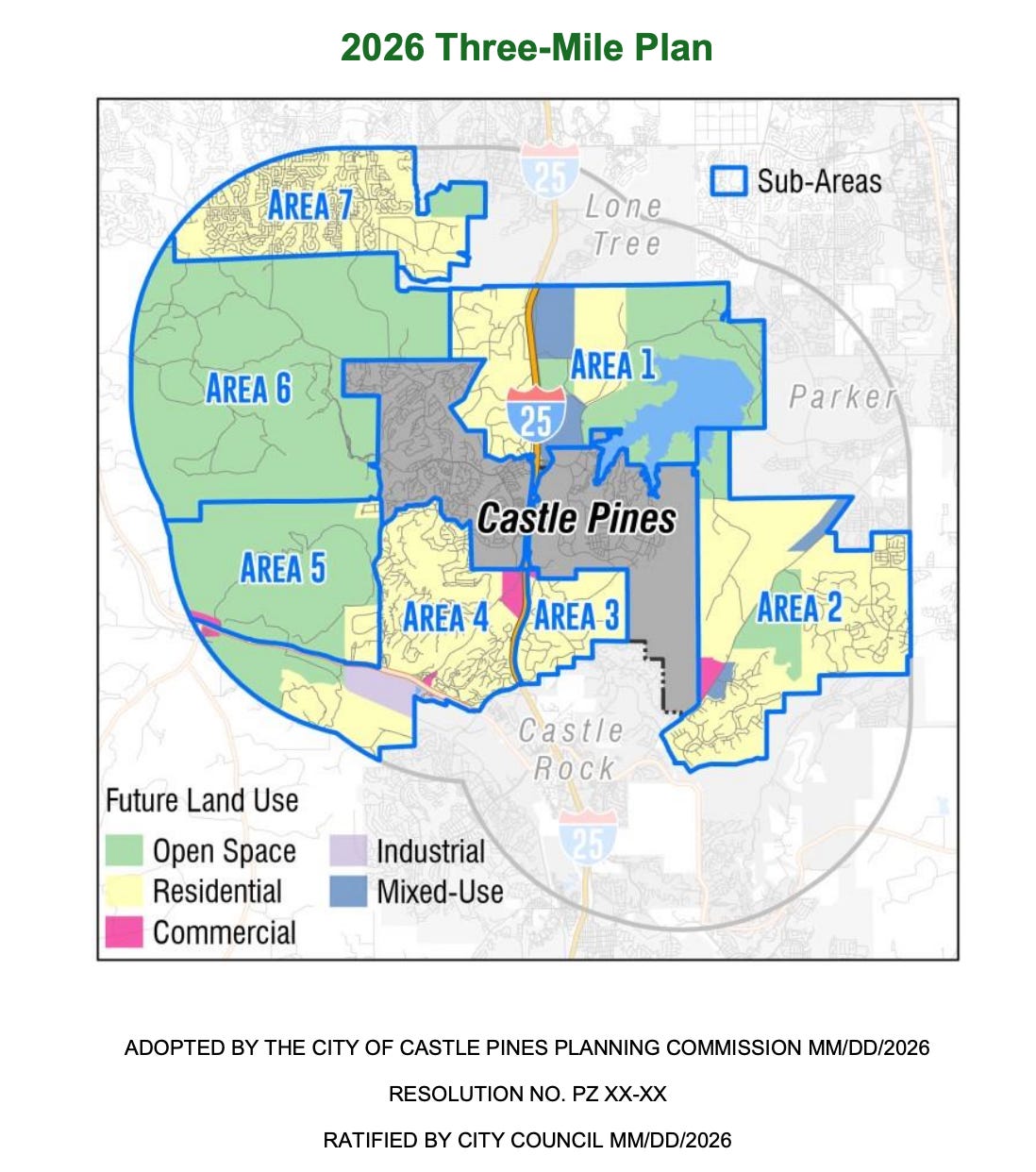
An annexation policy wasn’t the only thing the City was missing. There was also no current Three-Mile Plan on February 24, 2026. A Three-Mile Plan is an annexation master plan for the area in a three mile radius from a municipality’s current boundaries. According to state statute, prior to the final adoption of an annexation resolution, a municipality:
Must have a Three-Mile Plan in place.
That plan must be updated at least once a year.
And it should be part of the municipality’s Comprehensive Plan.
According to the Colorado Department of Local Affairs, “The failure to have a plan prior to the completion of an annexation could open a municipality up to litigation.”
The most recent Comprehensive Plan for the City of Castle Pines was adopted on June 24, 2021. That was before many of the homes in the Canyons - an expansion of Castle Pines east of I-25 - were built. That 2021 Comprehensive Plan reports that the most recent Three-Mile Plan at that time was from 2013. There is no evidence of an updated three-mile plan on the City’s website since that date.
The Castle Pines Planning Commission approved the adoption of an updated Three Mile Plan on April 23, 2026. That updated plan was on the agenda for presentation at the May 12 City Council Meeting.
These facts together suggest that there was no updated Three-Mile Plan in place at the time of the February 24, 2026 City Council resolution to declare Crowsnest eligible for annexation.
Citizen-Initiated Petitions
On April 7, the City Council passed Emergency Ordinance 26-05 to define procedures for dealing with citizen-initiated petitions; this was in response to citizens seeking guidance on Amendments 1 and 2. The need for the emergency ordinance suggests that when staff members received requests for information on how to set up petitions, they had no defined policies or procedures in place to guide their responses.
What happens next?
Supporters of Amendments 1 and 2 must collect 1,344 signatures to get each Amendment on the ballot. Packard and Ball say circulators are carrying petitions for both amendments and are working all over Castle Pines to collect signatures. They refer residents to FAQs and a schedule of signing events on the group’s website. August 4 is the final deadline to return petitions, and if enough signatures are verified, the Amendments will appear on the November ballot for city residents.
The questions we need answered:
Why was there no Three-Mile Plan more current than 2013 when the City Council approved eligibility for Crowsnest on February 24?
If the Crowsnest Annexation had received final approval without a current Three-Mile Plan, what exposure to litigation could have resulted for Castle Pines?
Related Stories
We founded a city to put voters first, rather than have them be an afterthought to the wishes of staff, contractors, and developers. That idea is the guiding concept for the amendments. We live in a community with a smart but not always fully engaged electorate. The problem has been one of engagement, and the City must shoulder much of the blame here.
When voters are not engaged, we end up allowing things like the purchase of city council seats by outside money groups, as happened last year. These amendments are part of the solution of better and stronger engagement. More needs to be done.
Great writing, as usual. Ya know, this idea of a donut surrounded by "districts" is what sank the tax base of Monmouth, Illinois, in the 1970's. They couldn't access property taxes from the surrounding area and therefore, the schools had to do without a lot of basic services. I imagine fire and police had the same problem. Castle Pines will be a real closed community in a few years without basic services, or really expensive services.